Courses After 12th Science: PCM and PCB Options Compared
PCM leads to engineering and architecture, while PCB leads to medicine, dentistry, pharmacy and nursing. This guide compares both streams, the non-JEE and non-NEET routes, and the 2027 entrance dates.

Arham Ansari
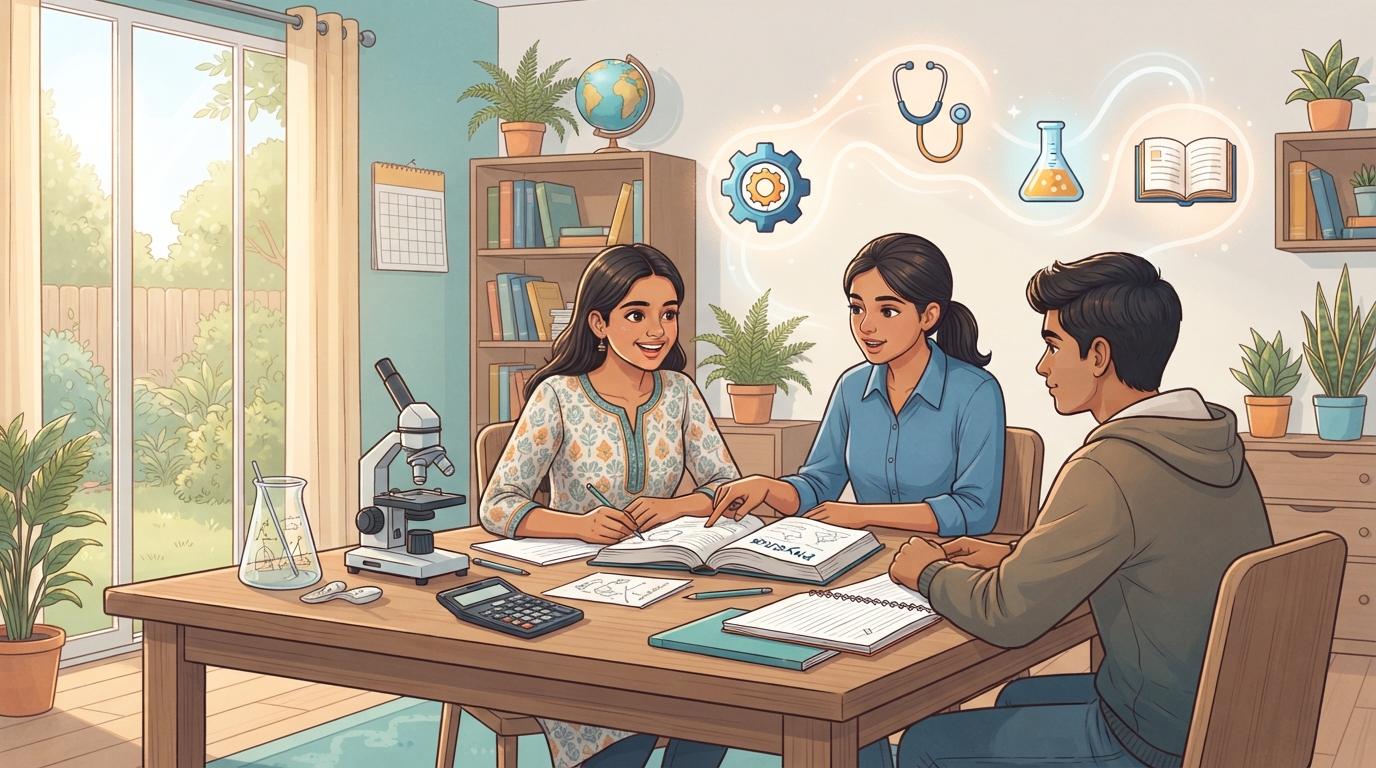
After Class 12 Science, most students choose between PCM (physics, chemistry and maths) and PCB (physics, chemistry and biology). PCM usually leads to engineering and architecture, while PCB leads to MBBS, dentistry, pharmacy and nursing, and both streams also open pure science and allied health careers. Many of these courses need an entrance exam, but some routes need no national test at all, so the right choice depends on the career you want and the marks you can realistically score. For the full list of options, see best careers after 12th science in 2026.
Courses after 12th science: what PCM opens and what PCB opens
Your stream decides which degrees you can enter directly. Most B.E., B.Tech and B.Arch courses expect Class 12 maths, while MBBS, BDS and AYUSH courses expect biology. Read the eligibility line on every college page before you finalise your stream, because some pharmacy and science courses accept either combination.
| Stream | Main degrees | Typical careers | Entrance you will face |
|---|---|---|---|
| PCM | B.E. or B.Tech, B.Arch, B.Sc in maths, physics or chemistry | Engineer, architect, data scientist, researcher | JEE Main, BITSAT, VITEEE, state CETs |
| PCB | MBBS, BDS, AYUSH (BAMS, BHMS, BUMS), B.Pharm, B.Sc Nursing, B.Sc biology | Doctor, dentist, pharmacist, nurse, biotechnologist | NEET UG, plus college or state tests for nursing and pharmacy |
If maths is not your strength, PCB still gives you a wide set of options. You can read more in career options without maths after 12th science.
Engineering without JEE: the routes that exist
JEE Main is the best-known doorway to engineering, but it is not the only one. Several private universities and state entrances run their own tests, and each one has its own dates, syllabus and cut-off.
JEE Main opens NITs, IIITs and other centrally funded institutes, and it is the first step to IITs through JoSAA counselling. The JEE Main 2027 Information Bulletin was published on 24 October 2026, and Session 1 registration closes on 22 November 2026. Session 1 is in late January 2027, and Session 2 runs from 2 to 7 April 2027 according to the NTA JEE Main website.
JoSAA 2026 ran five allotment rounds from 13 June to 16 July 2026, through the JoSAA portal. The 2027 window is expected to follow the same pattern (expected, based on the 2026 rounds). The 2026 counselling fee was INR 35,000 for General and OBC-NCL candidates and INR 17,500 for SC, ST and PwD candidates, and the 2027 fee is expected to be similar (expected, based on 2026).
These are the main non-JEE routes:
| Exam | Who it opens | 2027 timing |
|---|---|---|
| BITSAT | BITS Pilani, Goa and Hyderabad campuses, with about 10 integrated dual-degree B.E. programmes and one B.Pharm programme | Session 1 expected in mid-April 2027 and Session 2 in late May 2027 (expected, based on the 2026 dates of 15 to 17 April and 24 to 26 May) |
| VITEEE | VIT campuses | 27 April to 2 May 2027 (expected, per the official VIT schedule; the 2026 exam ran 28 April to 3 May) |
| SRMJEEE | SRM Institute of Science and Technology campuses | April to June 2027 (expected) |
| MHT CET, WBJEE, COMEDK, MET | State and private engineering colleges in Maharashtra, West Bengal, Karnataka and Manipal | Mostly April to June 2027 (expected) |
For BITSAT details, see the BITS Pilani admissions site. For VIT, see the VITEEE official website, and for SRM, see the SRM official website.
No JEE does not mean no entrance. Each exam has its own syllabus and cut-off, and a strong JEE score does not carry over. Pick two or three exams that fit your state and budget, and apply early, because several application windows open in the same months.
Medical and allied health beyond MBBS
NEET UG is the single entrance for MBBS, BDS and AYUSH courses such as BAMS, BHMS and BUMS. The NEET UG 2026 result was declared on 16 July 2026, with about 20 lakh candidates appearing and 11.21 lakh qualifying. In 2025, about 22.09 lakh appeared and 12.37 lakh qualified. The original 2026 exam was cancelled after a paper leak and a re-test was held later, so always follow the NTA NEET UG website for changes.
Qualifying is not the same as getting a seat. Seats are allotted through MCC counselling, and reporting for allotted seats in the special stray round closed on 16 November 2026.
For 2027, the exam is expected on 2 May 2027, the first Sunday of May, following the pattern of recent years (expected). If the 2025 to 2026 decline continues, around 10.2 to 11.2 lakh candidates could qualify (expected, a rough estimate based on 2026 figures from a re-test year).
PCB also opens careers that do not need MBBS. BDS leads to dentistry, B.Pharm leads to pharmacy, and B.Sc Nursing leads to nursing. Physiotherapy (BPT) is a popular choice, and our BPT course guide explains its eligibility, duration and scope. Paramedical diplomas in radiology and medical laboratory technology are shorter routes into hospitals and diagnostic labs. Entry to nursing, pharmacy and paramedical courses is usually through state or college tests, so check each college's rules before you apply. To see one of these careers in detail, read the pharmacist career profile.
Pure science and research careers in India
A B.Sc (Hons) in physics, chemistry, mathematics, biology or statistics is the classic route into research and teaching. Students from either PCM or PCB can choose it, and it keeps the most specialisations open for later.
IISERs run integrated MSc programmes and their own admission test, so look at their admission process early in Class 12. Research careers in astrophysics, materials science, biotechnology and data science usually need an MSc and often a PhD. Plan for postgraduate study from the start, and build lab or project experience during your B.Sc.
Starting pay in pure science is often lower than in engineering or medicine, so match the choice with your goals and the years of study you are ready for.
Science students who switch to Commerce or Design: is it a loss?
No, switching is not a loss. Many science students move into commerce, and the logic and numbers from PCM or PCB carry over. The Chartered Accountancy course accepts students from any Class 12 stream, so a science student can move into accountancy. BBA, economics and financial analysis are also open. If you are still deciding between the streams, compare the options in commerce, science or arts after 10th.
Design is a different route. Courses such as NID and UCEED use their own entrance tests and, in many cases, a creative portfolio. If design interests you, start building a portfolio in Class 11 or 12, because starting late leaves less preparation time.
Choosing when your marks are lower than you hoped
Start with the eligibility rule for each course, not the marks you wish you had. Many colleges set a minimum aggregate or a minimum mark in particular subjects, and some entrance exams depend on Class 12 marks for eligibility. Read the rule on the college page before you pay any application fee.
Low marks do not close every door. Practical options include:
- B.Sc, BCA or BBA courses at colleges that admit students on Class 12 marks or their own process
- Diploma and vocational courses in pharmacy, medical laboratory technology or nursing support, depending on your state
- Private university courses, where some admit students on merit or their own test
- Certified short courses that build the skills employers ask for
If your results are not what you expected, first check your board's re-evaluation rules. Our guide on what to do after scoring low in CBSE boards explains the next steps in order.
Before you decide, take a psychometric assessment and talk to a certified career counsellor. The assessment shows how your interests and working style fit each stream, and a counsellor can match that to your marks, budget and location. Infigon Futures offers both through its career counselling service.
Frequently Asked Questions
Can I become an engineer without JEE Main?
Yes. Several private universities and state entrances admit students to B.E. and B.Tech courses through their own tests, including BITSAT for BITS campuses, VITEEE for VIT and SRMJEEE for SRM. State exams such as MHT CET, WBJEE and COMEDK also open routes in their states. Each exam has its own dates, syllabus and eligibility, so pick the ones that fit your state, budget and marks. A strong JEE score does not carry over to these exams.
Can a PCB student do engineering after 12th?
Most B.E. and B.Tech courses expect Class 12 maths, so a PCB student usually cannot apply directly. PCB students can explore biology-linked routes instead, such as B.Sc biotechnology, B.Pharm or allied health degrees, which fit their subjects. Always read the eligibility line on each college page before you pay any application fee.
What is the difference between PCM and PCB after 12th?
PCM covers physics, chemistry and maths, and opens engineering, architecture, B.Sc maths and many data and technology careers. PCB covers physics, chemistry and biology, and opens MBBS, BDS, AYUSH, pharmacy, nursing and life-science research. Some pharmacy and science courses accept either stream. Choose PCM if you enjoy solving problems with numbers and models, and PCB if you enjoy health, living systems and lab work.
When is NEET UG 2027 expected?
NEET UG 2027 is expected on 2 May 2027, which is the first Sunday of May, following the pattern of recent years when the exam fell in early May. The official NTA notice on the NEET UG website sets the final dates, eligibility and exam rules. Students should plan their Class 12 revision around early May so they keep their NEET options open.
When does JEE Main 2027 Session 1 registration close?
Session 1 registration for JEE Main 2027 closes on 22 November 2026, according to the Information Bulletin published on 24 October 2026. Session 1 exams are in late January 2027, and Session 2 runs from 2 to 7 April 2027. Apply only through the official NTA portal at jeemain.nta.nic.in, and keep your scanned photograph and signature ready before you start.
Can a science student switch to commerce after 12th?
Yes. A science student can switch to commerce, and the Chartered Accountancy course accepts students from any Class 12 stream. The numbers, logic and analysis learned in PCM or PCB help in accounting, finance and economics courses. Many students find the switch works best when they start planning early and choose a course that matches their interests.
Which courses after 12th science do not need JEE or NEET?
Several routes do not need JEE or NEET. These include BITSAT for BITS campuses, VITEEE for VIT, SRMJEEE for SRM, and state or private engineering tests such as MHT CET, WBJEE and COMEDK. On the PCB side, B.Sc courses, B.Pharm, B.Sc Nursing and paramedical diplomas use their own college or state tests. Check the eligibility of each course before you apply.
Will low Class 12 marks stop me from getting into a science course?
Not always. Some colleges set a minimum aggregate or subject-wise mark, and entrance exams can also set eligibility rules. Where marks are low, many students still have routes such as B.Sc, BCA, BBA, diploma and vocational courses, depending on the college. Read each eligibility rule, check your board's re-evaluation options, and talk to a career counsellor to build a shortlist of at least three routes.
Conclusion
Choosing between PCM and PCB comes down to the career you want, so start there, then check the eligibility rules, the exam dates and two backup routes. The 2027 dates in this guide are either official or clearly marked as expected, so plan around them. If you are still confused about which course suits you, you can connect with Infigon Futures and talk to a career expert.
Before you decide: two free 2-minute checks
- 2 min · freeAre you AI-proof?AI will take the work of people who only do what a machine can do. Ten questions show your AI-proof score and your biggest gap.Check my AI-proof score
- 1 min · freeWhen will you earn your dream salary?Pick a career and the monthly salary you have in mind. See at what level and around what age people in that career get there, if they do.Run the salary reality check