
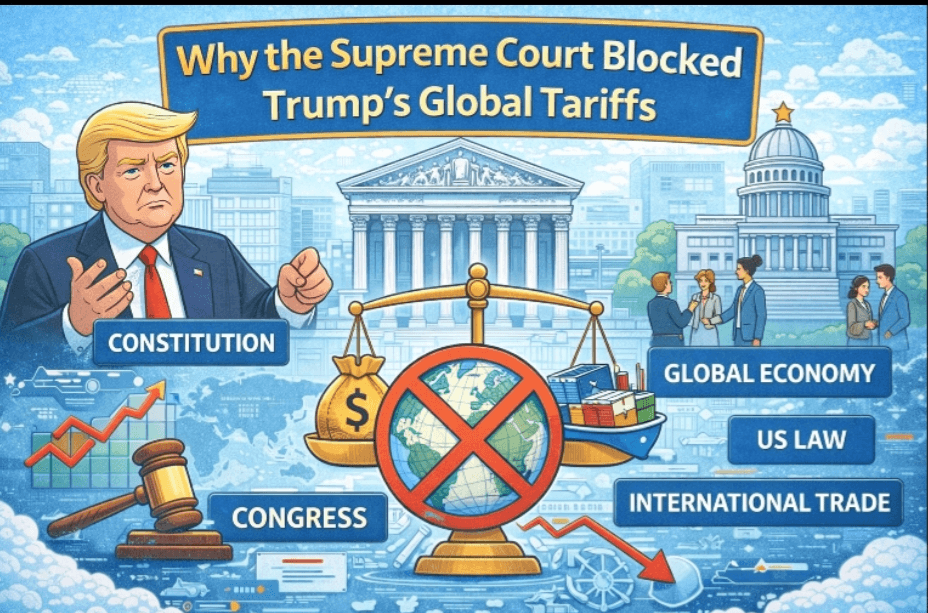
Lots of people were wondering about this.
The Supreme Court's decision caused a stir in the global economy. The stock market went crazy. The court basically told President Trump that he had gone far. They got involved in a debate about how much power one person should have over trade policy.
The Heart of the Fight: That 1977 Law
There's a law called the International Emergency Economic Powers Act or IEEPA. It's from 1977. Congress passed it to limit power after Watergate. They wanted to give presidents some flexibility during emergencies.. Nobody thought it would let presidents impose tariffs on everything.
That's what Trump did. He said the U.S. Trade deficit was an emergency. He used IEEPA to justify tariffs on lots of countries.
The administration said the law lets the president regulate imports during emergencies. They said tariffs are a form of regulation.
The Supreme Court said no.
The court's decision was clear. Regulating something is not the same as taxing it. The Constitution says Congress has the power to tax.
What the Court Actually Said
The court's decision was not about the law. It was about how the government works. The court said if Trump's interpretation were allowed it would change the relationship between the White House and Congress.
The court also talked about the " questions" doctrine. It says if the executive branch wants to do something they need clear authorization from Congress.
The Courts Strange Bedfellows
The 6-3 vote was surprising. Chief Justice Roberts, a conservative was joined by two conservatives who were appointed by Trump.
The dissenters were three justices. One of them, Kavanaugh , said the majority was making a deal out of this. He said Trump could use laws to impose tariffs.
Trumps Reaction
Trump was angry. He called the ruling "terrible" and "defective." He said he was disappointed in some members of the court.
He also said this wasn't the end. He announced tariffs under a different law.
The Markets Reaction
The stock market went crazy. Investors were unsure what to think.
The business community was also unsure. They praised the court's defense of the law.. They were worried about what comes next.
The Constitution Actually Has a Lot to Say About This
The Constitution gives Congress the power over tariffs. It's not ambiguous. The framers wanted to prevent the executive from having much control.
Over time Congress has delegated some of that authority to the president.. There are limits.
The court said Trump exceeded those limits.
What Other Countries Are Thinking
Other countries are being cautious. They don't know what Trump's next move will be.
The Billion-Dollar Question
What happens to the $175 billion already collected? The Supreme Court didn't answer that. Importers are already suing for refunds.
What Comes Next
Trump's announcement of new tariffs shows he's not backing down. He's going to keep pushing and testing boundaries. It's up to the courts and Congress to stop him if they can.
The new 10 percent tariff that Donald Trump announced on Friday will face its legal challenges. Trade lawyers are already looking for weaknesses in the law he used and Senate Democrats are calling for the administration to give people their money back.
Gavin Newsom, the governor of California said it is time for Donald Trump to pay the price. He thinks the tariffs are unfair and hurt working families.
Whether people will actually get their money back is another question. It would be very hard to make it happen. The government would have to find everyone who paid the tariffs, figure out how much they paid and send them a check. That is if the courts decide that refunds are necessary which is not a thing.
The Current Scenario
This case is about more than just tariffs. It is about whether the president can use emergency declarations to make policy decisions without Congress.
If Donald Trump had won this case it would have been a deal. Future presidents could have declared emergencies and imposed taxes, changed rules and moved money around without Congress's approval. That would have given the president a lot of power.
The court said no. They reminded us that the Constitution still matters. The separation of powers still matters. Congress still has a role even when it is not working well.
Does this mean the trade wars are over? No. Donald Trump has tools and he is already using them. Does it mean businesses can relax? Not really. The uncertainty is just moving to legal battles over new tariffs under new laws.
It does mean that for now the emergency declaration approach to trade policy has not worked. If the president wants to impose tariffs he needs to go through Congress. That is how the system was designed to work.
I feel a little better knowing that some rules are still in place. In a world where everything feels uncertain and the rules seem to change all the time it is good to know that some guardrails are still standing. Even if they are being tested more than before.
FAQs
1. Why did the Supreme Court block Trump’s global tariffs?
Ans. The Court ruled that the President exceeded constitutional authority by attempting to impose sweeping global tariffs without clear approval from Congress, particularly under emergency economic powers.
2. What law was used to justify the tariffs?
Ans. The administration relied on the International Emergency Economic Powers Act, which allows the President to regulate commerce during certain national emergencies.
3. Does this decision limit presidential power on trade policy?
Ans. The ruling reinforces constitutional limits, emphasizing that Congress holds primary authority over regulating foreign commerce, even though presidents play a role in trade negotiations.
4. How did the stock market react to the decision?
Ans. Financial markets experienced short-term volatility, as investors evaluated the broader implications for US trade policy and the global economy.
5. What does this mean for future trade policies?
Ans. Future administrations may need stronger congressional backing before imposing large-scale tariffs, ensuring trade actions align with constitutional principles and US law.