
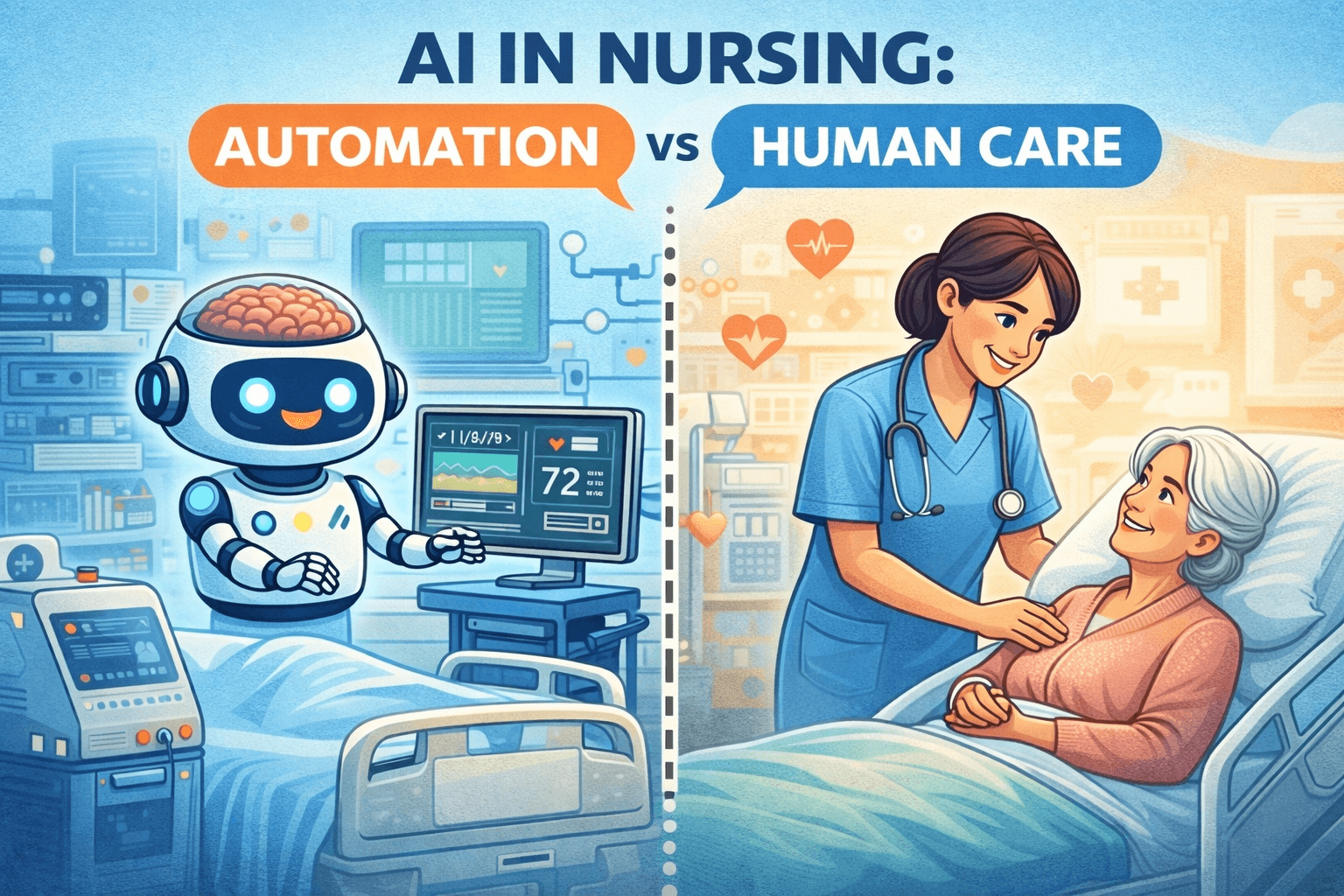
The healthcare industry is undergoing a quiet but powerful transformation. Artificial Intelligence (AI is becoming part of hospital wards, clinics, and nursing workflows handling tasks that once demanded hours of human effort. From monitoring patient vitals to assisting in diagnosis, AI promises efficiency and accuracy.
But nursing has always been more than tasks and technology. It is built on empathy, human connection, and emotional care. This raises an important question: Can automation enhance nursing without replacing its human heart?
The Growing Role of AI in Nursing
AI in nursing is not about robots replacing nurses. Instead, it focuses on supporting them. Modern AI systems are already being used to:
- Monitor patient vitals in real time
- Predict patient deterioration using data patterns
- Automate documentation and patient records
- Assist in medication management and error reduction
- Optimize staffing schedules and workload distribution
By handling repetitive and data-heavy tasks, AI allows nurses to spend less time on screens and more time with patients.
How Automation Improves Patient Care
Automation brings consistency and speed, two areas where healthcare systems often struggle. AI powered tools can analyze large volumes of patient data faster than any human, helping nurses and doctors make informed decisions sooner.
For example, AI can alert nurses before a patient’s condition worsens, enabling early intervention. Automated documentation reduces burnout caused by paperwork, one of the leading reasons nurses leave the profession. In this way, AI doesn’t replace care but rather it creates space for better care.
The Irreplaceable Human Side of Nursing
Despite technological advances, nursing remains deeply human. Comforting a frightened patient, reading emotional cues, or offering reassurance during difficult moments are skills no algorithm can replicate.
Patients often remember how a nurse made them feel more than the technology used in their treatment. Empathy, cultural understanding, ethical judgment, and emotional intelligence are central to nursing and these qualities cannot be automated.
AI may process data, but it cannot:
- Build emotional trust
- Understand unspoken fear or pain
- Provide moral and ethical decision-making
- Offer compassion in moments of vulnerability
This is where human nurses remain essential.
Finding the Right Balance
The future of nursing is not a battle between humans and machines, it is a partnership. AI should function as a supportive tool, not a replacement. When used thoughtfully, automation can strengthen nursing practice by reducing workload and improving accuracy, while nurses focus on what truly matters: patient connection and care.
Training nurses to work alongside AI is equally important. Understanding how to interpret AI insights, question results, and apply human judgment ensures technology serves healthcare rather than controls it.
Ethical Concerns and Trust
As AI becomes more common in healthcare, ethical considerations must be addressed. Data privacy, bias in algorithms, and over-reliance on technology are real concerns. Nurses play a critical role in advocating for patients, ensuring technology is used responsibly and ethically.
Human oversight is essential to maintain trust both in healthcare systems and in AI-driven decisions.
The Future of Nursing in an AI-Driven World
Rather than replacing nurses, AI is redefining the profession. Nurses of the future will be caregivers, decision-makers, and technology collaborators. Soft skills such as empathy, communication, and adaptability will become even more valuable alongside technical knowledge.
Those who can blend human care with technological understanding will shape the future of healthcare.
FAQs
1. Will AI replace nurses in the future?
Ans. No, AI is designed to support nurses by handling repetitive and data-driven tasks, not replace human caregiving and empathy.
3. How is AI currently used in nursing?
Ans. AI helps with patient monitoring, clinical documentation, medication management, risk prediction, and workflow optimization.
3. What skills will nurses need in an AI-driven healthcare system?
Ans. Along with clinical expertise, nurses will need adaptability, critical thinking, emotional intelligence, and basic digital literacy.
4. Does AI improve patient safety in hospitals?
Ans. Yes, AI can reduce errors by monitoring vital signs, flagging risks early, and assisting with accurate medication administration.
5. Can AI provide emotional care to patients?
Ans. No, emotional support, empathy, and human connection remain uniquely human aspects of nursing that AI cannot replicate