
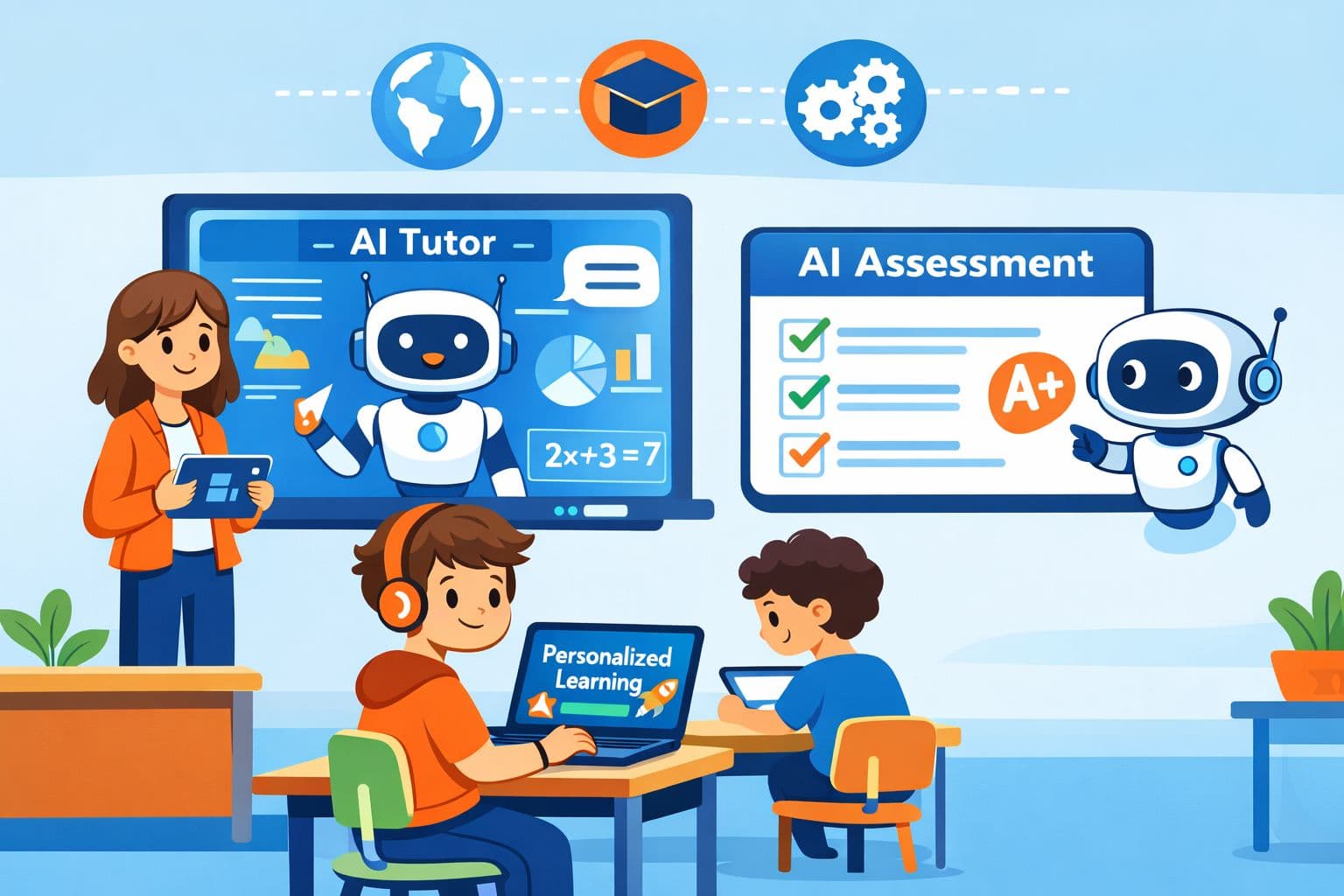
The year 2025 will be remembered as a defining moment in the education sector. Artificial Intelligence was no longer limited to experimental tools or elite institutions—it became an integral part of everyday teaching and learning across schools, colleges, and online platforms. From lesson planning to student evaluation, AI quietly reshaped how education works, making it more personalized, efficient, and inclusive.
AI in the Modern Classroom
One of the biggest changes in 2025 was how classrooms evolved. AI-powered software helped teachers design interactive lessons, generate practice questions, and adapt teaching styles based on student engagement levels. Smart classrooms now use analytics to understand which concepts students struggle with, allowing teachers to adjust their pace and approach in real time.
Students, on the other hand, benefited from AI tutors that provide instant explanations, personalized revision plans, and doubt-solving support beyond classroom hours. This shift reduced dependence on rote learning and encouraged concept-based understanding.
Personalized Learning at Scale
Traditional education often follows a single curriculum pace, but AI changed that model completely. Adaptive learning platforms now analyze student performance and create customized learning paths. Fast learners are challenged with advanced content, while those who need more time receive additional practice and support.
Online learning platforms saw massive growth in 2025, using AI to recommend courses, track progress, and improve digital skills. This made learning more flexible and accessible, especially for students in remote or underserved areas.
AI and Assessment: Beyond Marks
Assessment also underwent a major transformation. Instead of focusing only on final exams, AI-enabled tools now support continuous evaluation. Automated grading systems save teachers hours of manual work, while analytics-based assessments provide deeper insights into student strengths, weaknesses, and learning behavior.
AI-driven assessments also reduce bias by using standardized evaluation metrics. More importantly, they focus on skill development, critical thinking, and problem-solving rather than memorization alone.
Can AI Replace Teachers?
Despite its rapid growth, AI has not replaced traditional teaching methods—and it likely never will. Education is not just about information transfer; it involves emotional intelligence, mentorship, and human connection. AI acts as a support system, not a substitute. Teachers remain central to shaping values, creativity, and critical thinking, while AI handles repetitive and data-heavy tasks.
Initial Impact of AI on Education
The early impact of AI in education has been overwhelmingly positive. Teachers report reduced workload, students experience more engaging learning, and institutions benefit from better decision-making through analytics. However, challenges such as digital literacy, ethical AI use, and data privacy still require attention.
FAQs
1. How can AI be used to enhance education and learning?
Ans. AI enhances education by personalizing learning paths, offering instant feedback, and identifying student learning gaps. It helps teachers design smarter lessons and supports students with adaptive tools that match their pace and ability.
2. Can AI replace traditional teaching methods in education?
Ans. No, AI cannot replace traditional teaching. While it can automate tasks and provide learning support, teachers play an irreplaceable role in mentoring, emotional guidance, and developing critical thinking skills.
3. What is the initial impact of AI on education?
Ans. The initial impact of AI has been increased efficiency, better student engagement, and data-driven decision-making. Schools are seeing improved assessment accuracy and reduced teacher workload.
4. How is AI changing student assessment methods?
Ans. AI enables continuous and skill-based assessment rather than relying only on exams. It uses analytics to evaluate performance patterns, helping educators understand student strengths beyond marks.
5. What skills do students need to succeed in an AI-driven education system?
Ans. Students need digital literacy, problem-solving ability, adaptability, and critical thinking. Learning to work alongside AI tools is becoming as important as subject knowledge itself.