
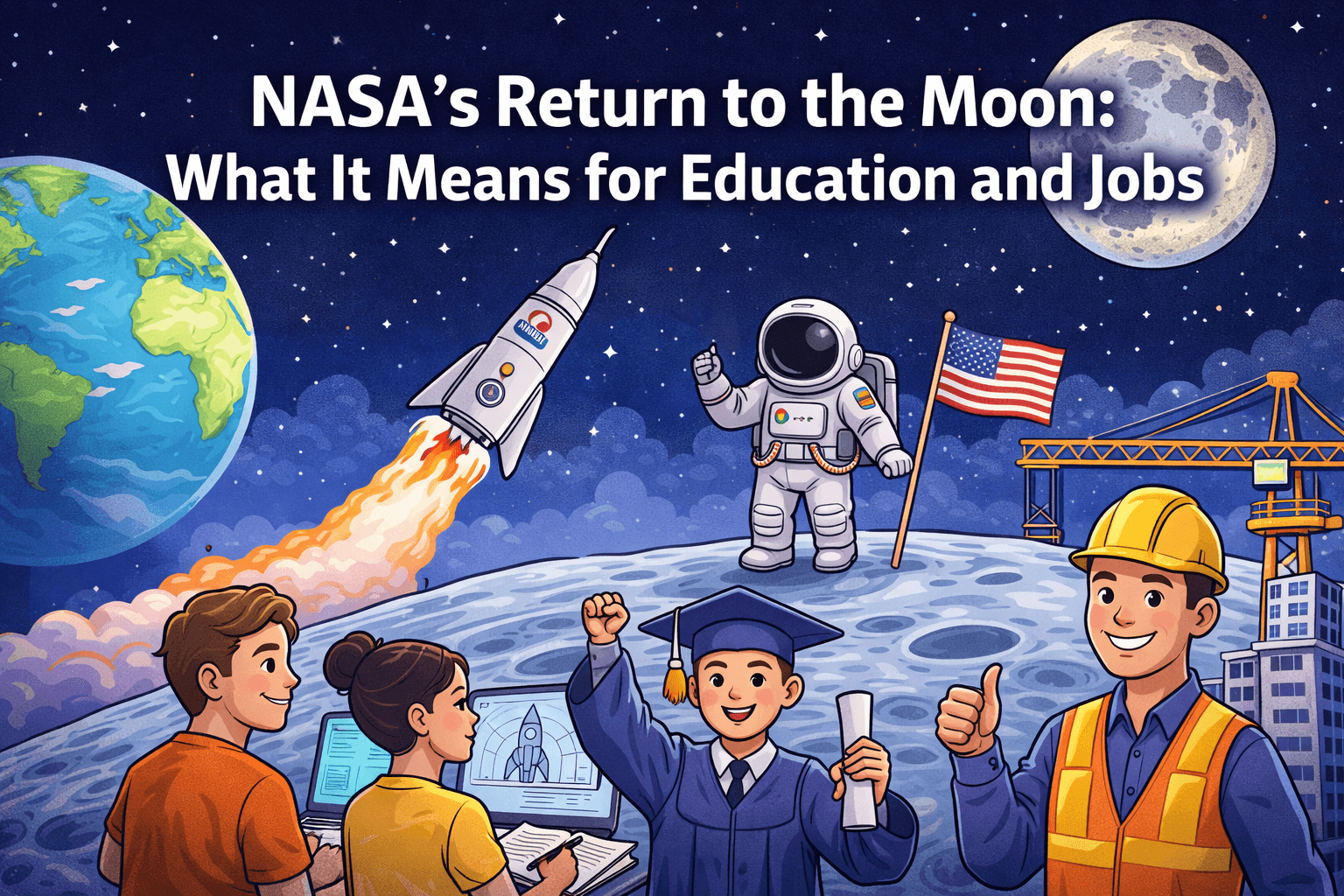
NASA’s return to the Moon is not just a leap for mankind; it is a giant leap for the next generation of professionals. As the Artemis program gears up to establish a permanent human presence on the lunar surface, the impact is being felt far beyond the launchpad. For students and recent graduates, this mission represents a golden era of opportunity. It is a call to action for those who have ever looked at the stars and wondered how they could be part of the journey. This movement is fundamentally reshaping how we approach education and how we define future jobs. By integrating high-level science with practical innovation, NASA is creating a pipeline for a workforce that is ready to tackle the challenges of the 21st century. Whether you are interested in technology, research, or even business operations, the space sector is opening doors that were previously considered science fiction.
The Educational Shift: Preparing for the Moon and Beyond
The NASA return to the Moon has sparked a massive transformation in classrooms and universities worldwide. The focus has shifted toward providing students with hands-on experience that mirrors real-world space challenges.
➤Curriculum Evolution: Schools are increasingly adopting STEM (Science, Technology, Engineering, and Mathematics) frameworks that use the Moon as a primary case study for physics and geology.
➤Engagement Programs: NASA provides unique learning resources to help students understand the complexity of a lunar mission.
➤Skill Development: Modern education now emphasizes innovation and critical thinking, which are essential for long-term exploration.
➤Interdisciplinary Learning: It is no longer just about rocket science; it is about how biology, law, and even ethics play a role in the future of space.
➤Academic Pathways: If you are looking for the right direction, understanding aerospace engineering eligibility is a great first step for aspiring engineers.
| Educational Level | Focus Area | Key Benefit |
|---|---|---|
| Primary School | STEM Foundations | Sparks curiosity and early interest in science. |
| High School | Technology & Robotics | Encourages participation in Artemis design challenges. |
| University | Specialized Research | Provides a platform for advanced lunar studies. |
| Graduates | Professional Training | Bridges the gap between theory and careers. |
New Frontiers in Careers and Jobs
The aerospace industry is expanding at an unprecedented rate, creating thousands of new jobs for a diverse range of professionals. This expansion is not limited to astronauts; it includes a vast network of support roles.
➤Engineering Roles: Designing habitats and rovers requires top-tier expertise in mechanical and electrical technology.
➤Data Science: Processing the massive amounts of data from the Moon is creating new careers in space science for data analysts.
➤Mission Support: Logistics, communications, and project management are vital to the success of any NASA project.
➤Growth in the Private Sector: Companies partnering with NASA are hiring graduates at record rates to support the lunar economy.
➤Career Guidance: Many wonder if there is a right age to start career counselling to prepare for such specialized fields.
Emerging Job Categories in the Space Sector
| Job Category | Key Responsibility | Required Expertise |
|---|---|---|
| Lunar Architect | Designing sustainable Moon bases. | Civil Engineering & Sustainability. |
| Space Lawyer | Drafting treaties for lunar resources. | International Law & Policy. |
| Robotics Technician | Maintaining autonomous lunar rovers. | Technology & AI. |
| Biotech Researcher | Studying plant growth in lunar soil. | Biology & Research. |
Opportunities for Students and Graduates
NASA is actively seeking fresh talent to join the Artemis generation. There are specific pathways designed to help young professionals enter the aerospace field.
➤NASA Internships: These programs offer a direct way for students to gain experience. You can explore NASA internship programs to find a role that fits your major.
➤Pathways Program: This provides a pipeline for graduates to transition into full-time NASA civil service jobs.
➤Direct Opportunities: For those ready to apply their skills, check the latest opportunities at NASA for various professional roles.
➤Scientific Discovery: The integration of AI in astrophysics is a growing field that attracts many tech-savvy students.
➤Specialized Education: Students in India can look into the top 3 astrophysics colleges in India to start their journey.
Student Engagement Milestones
| Milestone | Activity | Goal |
|---|---|---|
| Year 1-2 (College) | Join Artemis Challenges | Build foundational STEM skills. |
| Year 3 (College) | Apply for NASA Internships | Gain professional space industry exposure. |
| Final Year | Conduct Research | Contribute to the future of lunar science. |
| Post-Graduation | Apply for Jobs | Start a permanent career in aerospace. |
Innovation and the Future of Technology
The NASA Moon mission acts as a catalyst for technological innovation that eventually benefits life on Earth. The search for solutions to lunar challenges often leads to breakthroughs in everyday technology.
➤Resource Management: Learning to recycle water and air on the Moon improves sustainability technology on Earth.
➤Advanced Robotics: The autonomous systems developed for the mission are now being used in terrestrial manufacturing.
➤Communication Systems: New satellite technology is enhancing global connectivity.
➤Artemis Community: You can learn more about how to join Artemis and be part of this technological revolution.
➤Workforce Readiness: The demand for space careers ensures that the future workforce is highly skilled and adaptable.
FAQs
Q1. Why is NASA going to the Moon before Mars?
Ans. The Moon serves as a vital proving ground for deep space exploration. It allows NASA to test new technology, life support systems, and research methods only three days away from Earth. Success on the Moon is the essential first step before committing to a multi-year mission to Mars.
Q2. Can NASA settle human beings on the moon soon?
Ans. Yes, the goal of the Artemis mission is to establish a sustainable presence. While we won't see large cities immediately, NASA plans to build the Gateway station and lunar base camps where astronauts can live and work for extended periods.
Q3. Which would be the biggest incentive to return to the moon?
Ans. The biggest incentives are scientific discovery and economic growth. The Moon contains resources like water ice that can be turned into rocket fuel, fostering a new lunar economy and creating numerous jobs in the process.
Q4. What kind of education do I need for a career at NASA?
Ans. While STEM degrees are the most common, NASA also needs experts in business, law, communications, and medicine. A strong foundation in science and a focus on innovation are key for most space careers.
Q5. Are there opportunities for international students?
Ans. Yes, while some jobs require citizenship, NASA often collaborates with international agencies and offers various research grants and competitions open to the global community.