
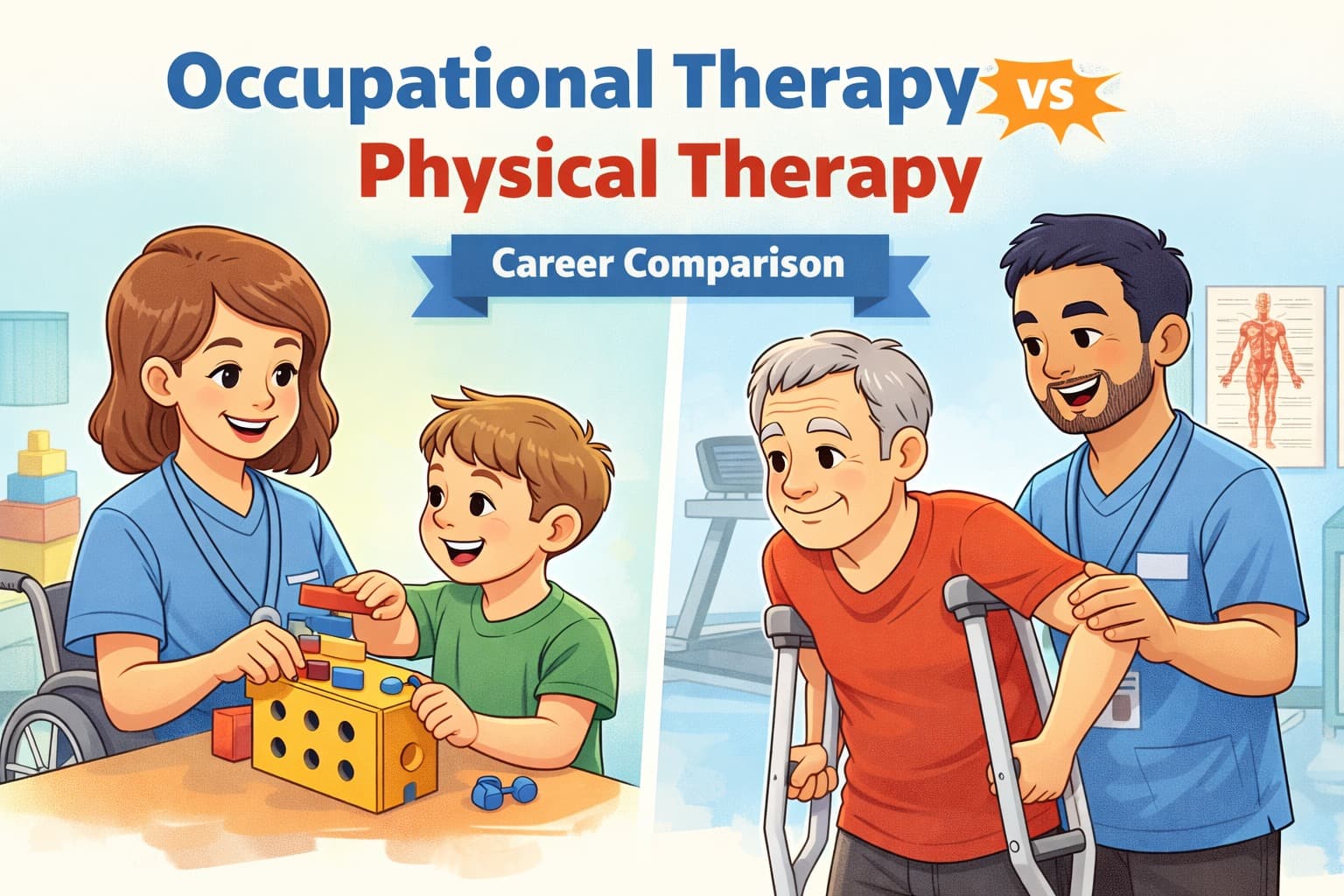
Choosing a career in the rehab sector is a noble and rewarding path. If you are someone who loves helping people regain their independence and live a better life, you might find yourself stuck between two very popular options. While both fields belong to the healthcare industry and focus on patient recovery, they approach healing from different angles. One focuses on the mechanics of movement, while the other looks at the activities that make life meaningful.
The difference between OT and PT often confuses students, but the distinction is quite simple once you see it in action. A physical therapist helps you walk to the kitchen, while an occupational therapist helps you cook the meal once you get there. Both roles are essential in modern therapy settings, and choosing between a physical therapy career or an occupational therapy career depends on whether you prefer focusing on body mechanics or the holistic "whole person" approach to daily living.
Understanding the Core Roles in Rehabilitation
In the world of rehab, the roles of physical and occupational therapists are distinct yet complementary. Understanding these differences is the first step in deciding which career path aligns with your interests.
➤Physical Therapy Focus: This field is primarily concerned with gross motor skills. These are large movements like walking, climbing stairs, or jumping. A professional in this field treats the actual physical impairment from a biomechanical perspective.
➤Occupational Therapy Focus: This discipline centers on fine motor skills and "occupations," which refers to any daily activity like dressing, writing, or using a computer. It takes a holistic approach, considering mental and emotional health alongside physical recovery.
➤Collaborative Care: Often, patients work with both. For example, after a stroke, a patient needs a physical therapist to regain leg strength and an occupational therapist to relearn how to button a shirt.
➤Preventative Measures: Both fields work on prevention. While PTs prevent future sports injuries or falls, OTs suggest environmental modifications to prevent accidents at home or work.
| Feature | Physical Therapy (PT) | Occupational Therapy (OT) |
|---|---|---|
| Primary Goal | Improve mobility and reduce pain. | Increase independence in daily tasks. |
| Movement Type | Gross motor skills (walking, balance). | Fine motor skills (grasping, cognitive tasks). |
| Approach | Biomechanical and physical. | Holistic (physical, mental, and social). |
Educational Paths: How to Get Started
The education & training required for these roles is intensive. You cannot simply jump into these jobs without a solid academic foundation and specific certifications.
➤How to become a physical therapist: You must start with a bachelor's degree, followed by a Doctor of Physical Therapy (DPT) degree. This usually takes about seven years of total study. You can check the specific physical therapy degree requirements to see the standard path.
➤How to become an occupational therapist: The entry-level requirement is usually a Master’s degree (MOT), though many are now opting for a Doctorate (OTD). The occupational therapy education requirements typically involve a four-year degree followed by two to three years of specialized graduate school.
➤Clinical Hours: Both paths require hundreds of hours of supervised clinical rotations. This hands-on therapy experience is vital for developing the empathy and technical skill needed for the job.
➤Licensing: Regardless of the path, you must pass a national exam (the NPTE for PTs or the NBCOT for OTs) and obtain state licensure to practice.
For students in certain regions, the process might differ slightly. You might find it helpful to read a step-by-step career guide for students in India to understand the global variations in certification.
Skills Required for Success
To excel in a physical therapy career or an occupational therapy career, you need more than just book knowledge. The "soft skills" are often what make a therapist truly great.
Physical Therapy Skills
➤Anatomical Knowledge: A deep understanding of how muscles and bones interact.
➤Physical Stamina: You will be on your feet, lifting patients and demonstrating exercises.
➤Observation: The ability to spot tiny irregularities in a patient's gait or posture.
➤Technical Proficiency: Using equipment like ultrasound machines or electrical stimulation.
Occupational Therapy Skills
➤Problem Solving: Finding creative ways to adapt a patient's home or workspace.
➤Empathy: Understanding the frustration of losing independence in daily life.
➤Cognitive Assessment: Evaluating how a patient's brain health affects their physical actions.
➤Creativity: Designing "games" or tasks that double as therapeutic exercises.
Salary and Job Outlook Comparison
When choosing a career, financial stability is a major factor. Both fields offer competitive pay and excellent job security as the global population ages.
➤Physical Therapist Salary: On average, PTs tend to earn slightly more due to the doctoral requirement. The physical therapist salary in the United States averages around $101,000 per year, though this varies by setting.
➤Occupational Therapist Salary: The occupational therapist salary is also very strong, typically averaging around $98,000 annually.
➤Market Demand: The job outlook for physical therapists is projected to grow much faster than average, with thousands of new physical therapist jobs opening every year.
➤Growth in OT: Similarly, the job outlook for occupational therapists is very positive. The rise in pediatric needs and geriatric care ensures that occupational therapist jobs remain plentiful.
| Metric | Physical Therapist | Occupational Therapist |
|---|---|---|
| Median Annual Salary | ~$101,000 | ~$98,000 |
| Typical Degree | Doctorate (DPT) | Master's (MOT) or Doctorate (OTD) |
| Growth Rate (to 2033) | ~14% | ~11% |
Choosing the Right Setting
Where do these professionals actually work? The environment can change your daily experience significantly.
➤Hospitals and Clinics: Both are heavily represented here, focusing on acute recovery and post-surgery rehab.
➤Schools: OTs are very common in schools, helping children with developmental delays. If you are interested in specialized counseling, you might also look into a marriage and family therapy career which often intersects with social work.
➤Health: Visiting patients in their homes to help them adapt their living environment to their physical needs.
➤Sports Facilities: This is where you will find the highest concentration of PTs working on injury recovery.
Understanding the broader scope of rehabilitation services globally can help you see the bigger picture of where these roles fit in the healthcare system.
FAQS:
Q1. Which career is easier to get into, OT or PT?
Ans. Neither is "easy," as both require a high GPA and significant graduate-level study. However, OT currently has a slightly lower barrier to entry in terms of the degree level required (Master's vs. Doctorate), though this is changing as more OT programs move toward the doctoral level.
Q2. Can a physical therapist perform occupational therapy tasks?
Ans. While there is overlap, they are legally and professionally distinct. A PT might help with some functional movements, but they cannot bill for or provide specialized occupational assessments, just as an OT would not typically perform high-level athletic gait analysis. If you are interested in the physical side specifically, you can explore a physiotherapy course for more details.
Q3. Will AI eventually replace these therapy jobs?
Ans. It is highly unlikely. While technology helps with data and tracking, the human touch and emotional intelligence required for rehab are irreplaceable. You can read more about why AI cannot replace therapists in our detailed breakdown.
Q4. Do physical therapists make more money than occupational therapists?
Ans. Generally, yes. The physical therapist salary is usually a few thousand dollars higher per year than the occupational therapist salary, largely because the Doctor of Physical Therapy is now the mandatory entry-level degree.
Q5. Can I switch from PT to OT later in my career?
Ans. It is not an easy switch. Because the education & training requirements are so specific to each license, you would likely need to go back to graduate school to earn the specific degree and pass the certification exam for the other field.