
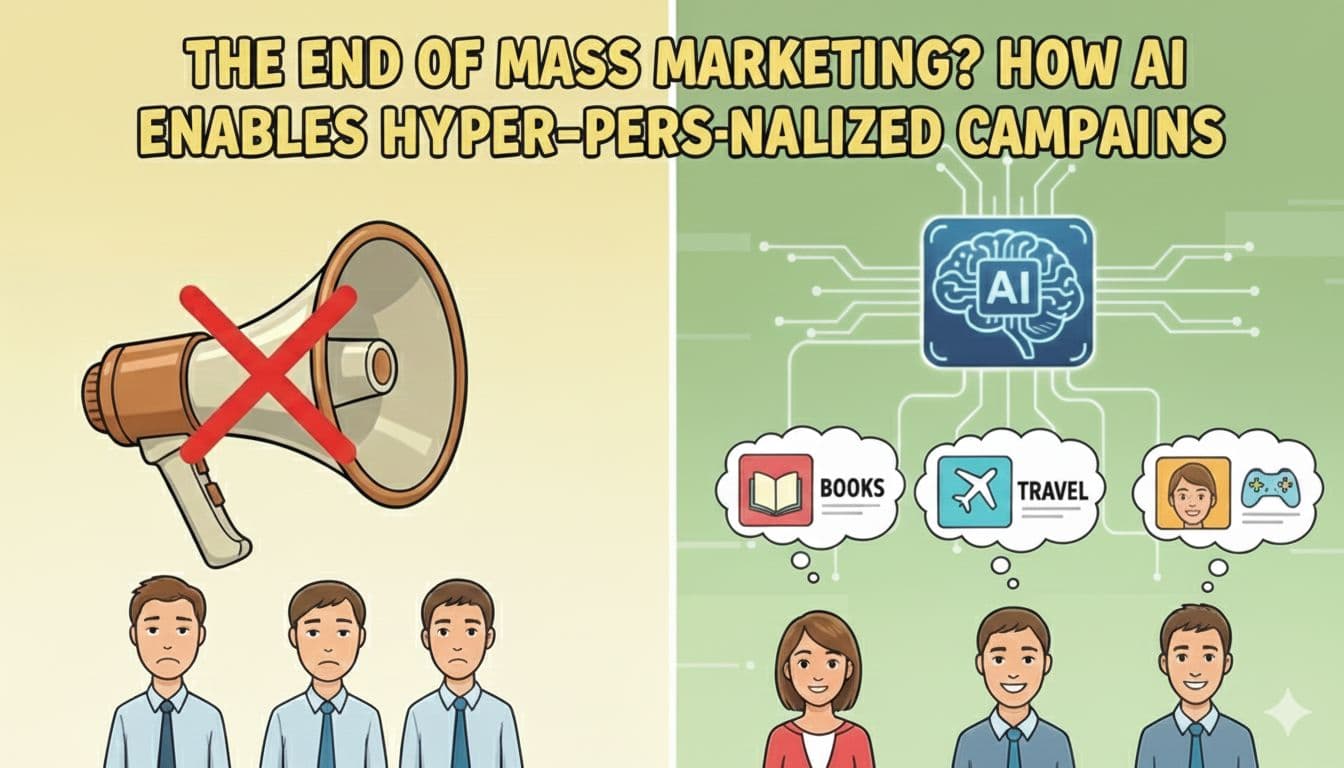
For decades, mass marketing followed a simple idea: send one message to as many people as possible and hope it works. TV ads, newspaper promotions, email blasts — all based on averages, not individuals. But consumer behavior has changed. People now expect brands to understand their needs, preferences, and timing.
This shift has led to a big question in modern business: Is mass marketing coming to an end?
With artificial intelligence transforming how brands collect, analyze, and act on data, marketing is no longer about “everyone.” It’s about the right person, at the right time, with the right message. This is where AI-powered hyper-personalization comes in.
Why Mass Marketing Is Losing Relevance
Mass marketing struggles in today’s digital ecosystem because:
- Consumers are overwhelmed with content and ads
- Generic messages feel irrelevant and easy to ignore
- Customer journeys are no longer linear
- Engagement depends on personalization, not volume
AI changes this by allowing marketers to move from broad segments to individual-level targeting, making campaigns more meaningful and effective.
How AI Enables Hyper-Personalized Marketing
AI uses data from multiple sources — browsing behavior, purchase history, CRM systems, social media interactions, and content engagement — to understand customers deeply. Instead of guessing, marketers can now predict intent and behavior.
Key areas where AI drives personalization:
- Product recommendations tailored to individual users
- Dynamic website and email content
- Personalized ad creatives and messaging
- Automated customer journey optimization
- Real-time campaign adjustments
This approach doesn’t just improve engagement — it improves trust and long-term customer relationships.
How Does AI Impact Decision-Making in Marketing?
AI significantly improves marketing decision-making by replacing intuition with insights.
Instead of asking “What do we think will work?”, marketers ask “What does the data show?”
AI helps by:
- Identifying high-value customer segments
- Predicting customer lifetime value
- Forecasting campaign performance
- Detecting patterns humans might miss
With AI, decisions become faster, smarter, and more accurate — especially in competitive digital markets where timing matters.
How Can AI Help with Digital Marketing Data Analysis?
Digital marketing generates massive amounts of data — far more than humans can process manually. AI tools simplify this by turning raw data into clear insights.
AI helps marketers:
- Analyze customer behavior across platforms
- Measure engagement, conversions, and drop-off points
- Detect trends in real time
- Optimize campaigns automatically
This allows brands to focus less on spreadsheets and more on strategy, creativity, and growth.
How Can AI Prompts Improve Marketing Strategies?
AI prompts play a major role in content creation and strategic planning. When used correctly, they help marketers generate ideas, refine messaging, and adapt content for different audiences.
AI prompts can help:
- Create personalized ad copies
- Optimize SEO content
- Generate email subject lines
- Test multiple messaging angles quickly
- Align tone with customer psychology
Rather than replacing creativity, AI prompts enhance human thinking and speed up execution.
How Is AI Going to Impact the Future of Digital Marketing?
The future of digital marketing will be:
- Predictive, not reactive
- Personalized, not generic
- Automated, but still human-guided
Key trends shaping the future include:
- AI-driven CRM systems
- Advanced customer analytics
- Emotion-based targeting
- Real-time personalization
- Ethical and privacy-focused AI use
Marketers who adapt to AI will gain a competitive edge, while those who rely only on traditional methods risk falling behind.
The Role of AI in Customer Engagement and Growth
AI doesn’t just improve advertising — it improves the entire customer experience.
From chatbots and recommendation engines to personalized onboarding and retention strategies, AI ensures customers feel understood rather than targeted. This leads to:
- Higher engagement
- Better conversions
- Stronger brand loyalty
- Sustainable business growth
Hyper-personalization is no longer a luxury — it’s becoming the standard.
FAQs
Q1: How does AI impact decision-making in marketing?
Ans. AI improves marketing decision-making by analyzing large datasets to predict customer behavior, optimize campaigns, and reduce guesswork through data-driven insights.
Q2: How can AI help with digital marketing data analysis?
Ans. AI tools process customer data in real time, identify trends, track performance metrics, and provide actionable insights that improve campaign effectiveness.
Q3: How can AI prompts improve marketing strategies?
Ans. AI prompts help marketers generate personalized content ideas, optimize messaging, test multiple strategies quickly, and align campaigns with audience psychology.
Q4: How is AI going to impact the future of digital marketing?
Ans. AI will make digital marketing more personalized, predictive, automated, and customer-centric while increasing efficiency and engagement across platforms.
Q5: Is mass marketing becoming obsolete because of AI?
Ans. Mass marketing is losing effectiveness as AI-driven personalization delivers more relevant, targeted, and meaningful customer experiences