
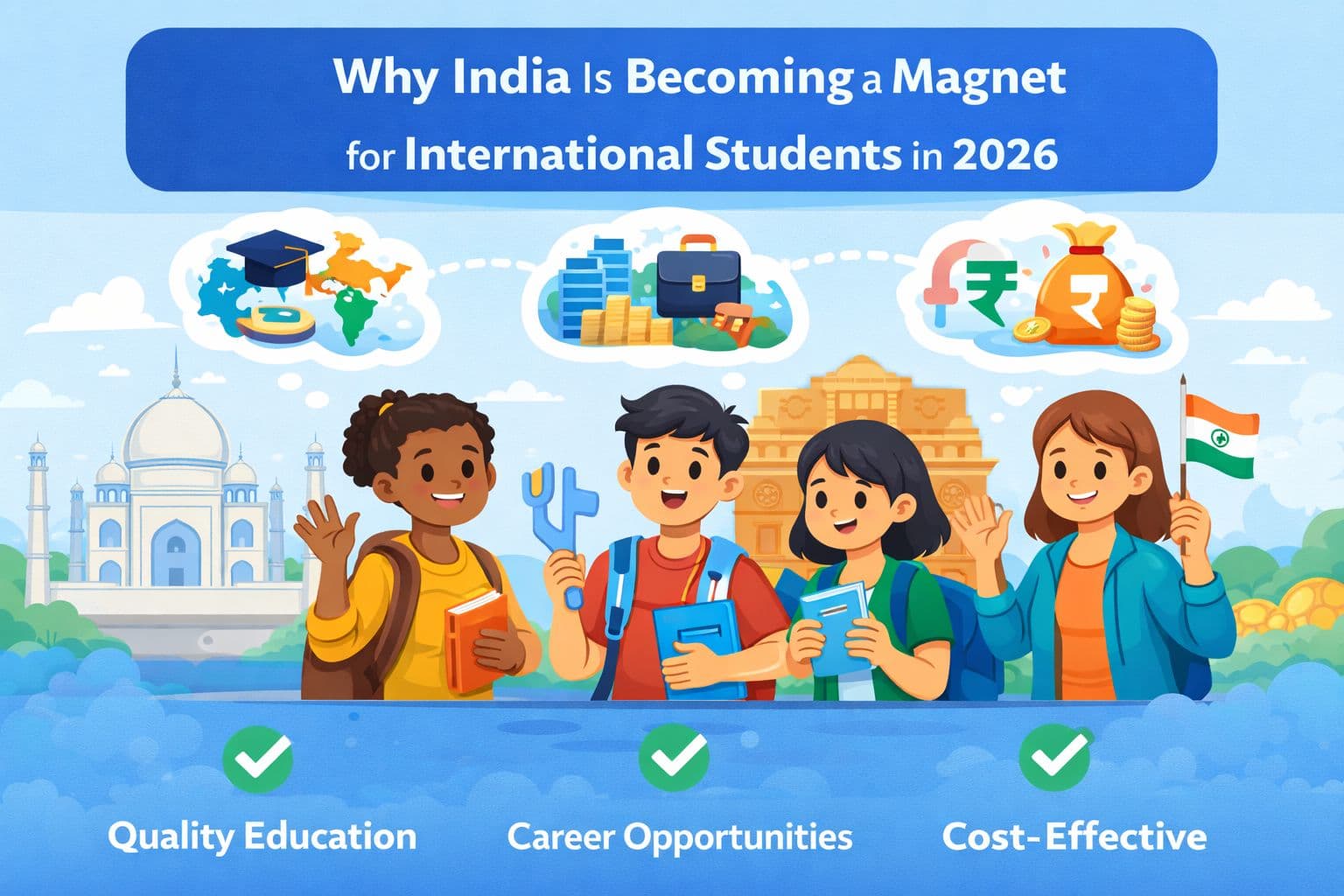
For decades, students from Asia, Africa, and the Middle East looked mainly to the US, UK, or Australia for higher education. But by 2026, the narrative is shifting. India is no longer just a source of international students—it is rapidly becoming a global education destination.
With major education reforms, affordable quality degrees, cultural diversity, and a strong focus on innovation, India is positioning itself as a compelling choice for students worldwide.
The Global Appeal of Studying in India
One of the biggest reasons international students are turning towards India is cost-effectiveness. Compared to Western countries, tuition fees and living costs in India are significantly lower, without compromising on academic depth. This makes Indian universities attractive for students who want quality education without long-term financial burden.
Additionally, India offers a unique blend of traditional knowledge and modern technology. From engineering and medicine to management, research, and humanities, Indian institutions are expanding globally relevant courses aligned with industry needs.
How NEP Is Changing the Game
The National Education Policy (NEP) has played a crucial role in reshaping India’s higher education system. Its emphasis on multidisciplinary learning, academic flexibility, and global collaboration has made Indian universities more compatible with international standards.
Foreign students now benefit from:
- Flexible degree structures
- Multiple entry and exit options
- Increased focus on research and innovation
- Simplified admission and credit transfer systems
These reforms make studying in India more transparent, student-friendly, and globally aligned.
Cultural Diversity as a Learning Advantage
India’s cultural richness is another strong pull factor. International students are exposed to diverse languages, traditions, and perspectives, helping them develop global adaptability. This cultural immersion goes beyond classrooms and prepares students for international careers in a deeply practical way.
Growing Focus on Research and Innovation
India is investing heavily in research universities, technology hubs, and innovation ecosystems. With collaborations between global institutions and Indian colleges increasing, students now have access to cutting-edge research opportunities at a fraction of global costs.
This shift has especially boosted India’s reputation in fields like:
- Technology and AI
- Sustainability and climate studies
- Healthcare and biotechnology
- Business analytics and entrepreneurship
FAQs
1.How can NEP revolutionise India’s education system?
Ans. NEP promotes flexibility, interdisciplinary learning, global collaboration, and research-driven education. It aligns Indian education with international standards while keeping it accessible and inclusive.
2.Will the new education system of India be helpful?
Ans. Yes. It focuses on skill development, critical thinking, and real-world application, making students more employable and globally competitive.
3. What scholarships are available for international students in India?
Ans. India offers numerous scholarships through government schemes, universities, and private institutions, making education more affordable for foreign students.
4. How easy is it for international students to get a student visa in India?
Ans. India has simplified its visa process, with digital applications, faster approvals, and extended validity for students enrolled in recognized institutions.
5. Which Indian universities are most popular among international students?
Ans. Top choices include the Indian Institutes of Technology (IITs), Indian Institutes of Management (IIMs), Jawaharlal Nehru University (JNU), and universities offering globally recognized programs in medicine, engineering, and business.