
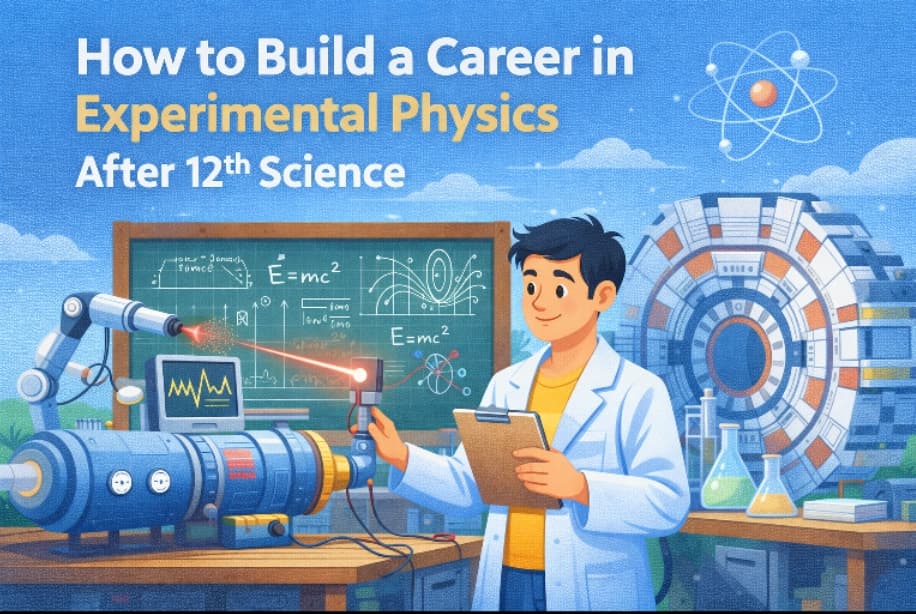
How to Build a Career in Experimental Physics After 12th Science
If you’ve always been the curious one in the lab, more interested in how a laser works than just reading about it, then learning How to Build a Career in Experimental Physics After 12th Science is your first step toward a thrilling future. Theoretical knowledge is limited to only pen and paper whereas in experimental physics, you need to get your hands dirty in experimenting, approving/disapproving the laws.
Who is a Physicist in the Modern World?
Before kicking off the roadmap, the first thing is to understand who is a physicist. A physicist is a scientist who deals with the study of physics, the fundamental properties of matter and energy. While a theoretical physicist builds mathematical models, an experimental physicist builds the machines—like particle accelerators—to test those models.
How to Build a Career in Experimental Physics After 12th Science
Skills Needed for Experimental Physics
To succeed in this field, students should develop:
- Strong laboratory skills
- Data analysis and statistics
- Programming basics (Python, MATLAB)
- Instrumentation knowledge
- Scientific writing and research ethics
These skills make you competitive in research labs and institutions.
How to Become a Physicist: Your Step-by-Step Roadmap
Acknowledging how to become a physicist requires a detailed commitment to academic excellence. It isn't just a 3-year degree; it’s a journey of discovery.
Step 1: Foundation in 12th Science
Your journey begins with a strong score in Physics and Mathematics. Most top-tier research institutes in India require at least 60-75% in your board exams to even consider your application.
Step 2: Choosing the Right Undergraduate Degree
To understand how to be a physicist, you must choose between a B.Sc. in Physics or a B.Tech. in Engineering Physics.
- B.Sc. (Hons) Physics: Best for those wanting a pure science route.
- B.Tech. Engineering Physics: Ideal for experimentalists who love the "building" side of science.
Step 3: Crack the Entrance Exams
In India, getting into the best institutes involves clearing exams like JEE Advanced (for IITs), IAT (for IISERs), or NEST (for NISER). These institutions are the breeding grounds for future Nobel laureates.
Salary of a Physicist in India: What to Expect
One of the most common questions students ask is about the salary of a physicist in India. While passion drives the work, financial stability is important. Physicist Salary in India (Entry to Senior Level) The physicist salary in India varies significantly based on whether you are in academia, a government lab like ISRO or BARC), or the private sector.
| Experience Level | Estimated Annual Salary (INR) |
|---|---|
| Entry Level (JRF/SRF) | ₹4.5 Lakhs – ₹7 Lakhs |
| Assistant Professor / Scientist C | ₹10 Lakhs – ₹15 Lakhs |
| Senior Scientist / Professor | ₹18 Lakhs – ₹28 Lakhs+ |
Compared to this, the theoretical physicist salary in purely academic roles might be slightly lower in the private sector but remains competitive within government research frameworks.
Research Opportunities After Physics Degree
Graduates can work in:
- National research labs (ISRO, BARC, DRDO)
- Universities and colleges
- Private R&D labs
- International research institutions
Research careers are ideal for those passionate about discovery and innovation.
How to Become Physics Professor or Researcher
If you enjoy sharing knowledge, you might wonder how to become a physics professor. This path requires you to clear the NET (National Eligibility Test) after your Master's. A PhD is almost always mandatory for permanent faculty positions at reputable universities.
How to Become a Theoretical Physicist vs Experimentalist
While this guide focuses on experiments, knowing how to become a theoretical physicist is useful. The path is similar: B.Sc. → M.Sc. → PhD. The difference lies in your PhD research—theoretical physicists spend their days with advanced calculus and coding, while experimentalists spend theirs with vacuum pumps and cryogenics.
FAQs
Q1. How to go for the research field in physics after the 12th?
Ans. The best way is to enroll in an Integrated BS-MS program at an IISER or NISER. These 5-year programs are designed specifically to turn students into researchers. You can also do a B.Sc. and then clear the IIT-JAM exam to get into an IIT for your Master's.
Q2. How to be a physicist in a government lab?
Ans. To work at places like ISRO or DRDO, you usually need to clear their specific recruitment exams (like the ICRB for ISRO) or have a valid GATE score for scientist positions.
Q3. Is the physicist salary in India comparable to IT jobs?
Ans. At senior levels, yes. While IT might offer higher starting packages, a senior scientist at a government organization enjoys significant perks, including housing, medical benefits, and high social prestige.