
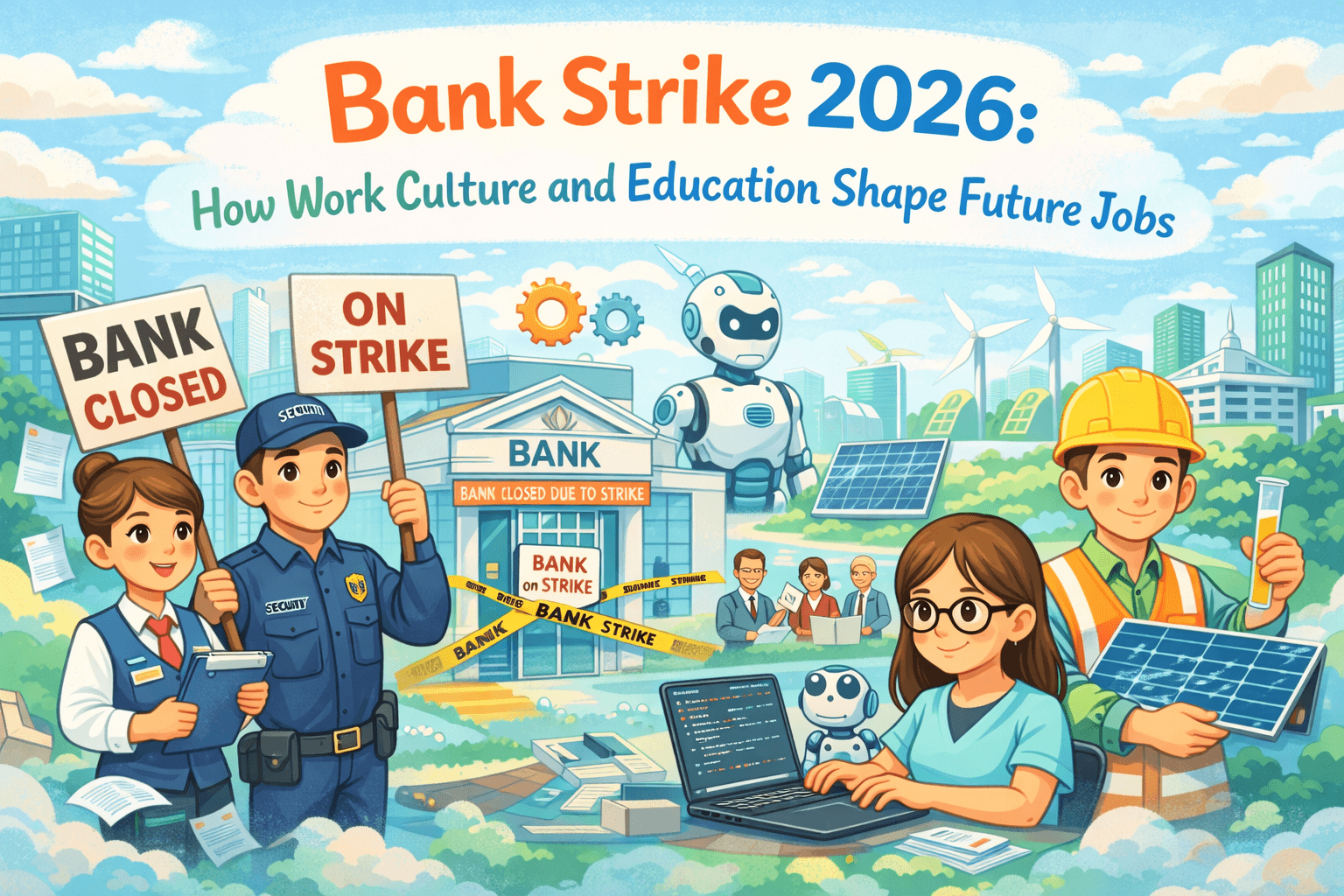
The Bank Strike 2026 has once again drawn attention to the realities of working in India’s banking sector. While strikes have occurred in the past, this one feels different. It reflects deeper concerns around work culture, job pressure, evolving roles, and the future of banking careers—especially for students planning to enter this field.
For young aspirants, this strike is not just news. It’s a signal to rethink how education and career planning align with real workplace expectations.
Why Did the Bank Strike Happen in 2026?
The 2026 bank strike emerged from a mix of long-standing and modern challenges. Bank employees are dealing with increasing workloads due to digital banking expansion, staff shortages in branches, sales-driven targets, and concerns about privatization. These factors have collectively changed the everyday experience of banking professionals.
What was once seen as a stable and predictable career is now more demanding and performance-oriented.
Changing Work Culture in Banking
Work culture in banking has shifted dramatically over the years. Employees today face longer working hours, higher accountability, and constant pressure to adapt to technology-driven systems. Even public sector banks are no longer immune to sales targets and performance reviews.
This change has made many students question whether traditional assumptions about banking jobs still hold true.
Public and Private Bank Jobs: How They Differ Today
Public sector banks continue to offer job stability and structured growth, but the pace of change is slower. Private banks, on the other hand, emphasize innovation, performance-based rewards, and faster career progression—often at the cost of higher stress levels.
In 2026, the gap between the two is narrowing when it comes to workload and expectations.
Role of Education in Shaping Banking Careers
Education for banking jobs is no longer limited to finance or commerce degrees alone. Modern banking roles demand a blend of technical knowledge, analytical thinking, digital literacy, and customer-handling skills.
Students who focus only on clearing exams without building relevant skills may find it difficult to sustain long-term growth in this sector.
Future of Banking Jobs
The future of bank jobs will be shaped by automation, fintech, and digital transformation. Clerical and repetitive roles are gradually reducing, while roles related to data analysis, risk management, compliance, and digital operations are growing.
Banking careers are not disappearing—but they are becoming more skill-driven than ever before.
What Students Should Learn from the Bank Strike 2026
The biggest lesson for students is that career choices should not be based on outdated perceptions. Banking can still be a strong career option, but only for those who are prepared for changing work cultures and continuous learning.
Understanding personal strengths, stress tolerance, and long-term goals is essential before committing to this path.
FAQs
Q1. Why did the bank strike take place in 2026?
Ans. It occurred due to workload pressure, staffing issues, wage concerns, and changing expectations in the banking sector.
Q2. Are banking jobs still secure in the future?
Ans. They offer stability, especially in public banks, but job security increasingly depends on skills and adaptability.
Q3. Is banking a good career choice for students today?
Ans. Yes, if students are ready for evolving roles, technology adoption, and performance-based work.
Q4. What skills are important for future banking jobs?
Ans. Digital finance knowledge, analytical skills, communication, and customer management are crucial.
Q5. Should students still prepare for bank exams?
Ans. Yes, but with a realistic understanding of work culture and alternative career options.
Q6. How can students make better career decisions in banking?
Ans. By combining academic preparation with self-awareness and skill development.