
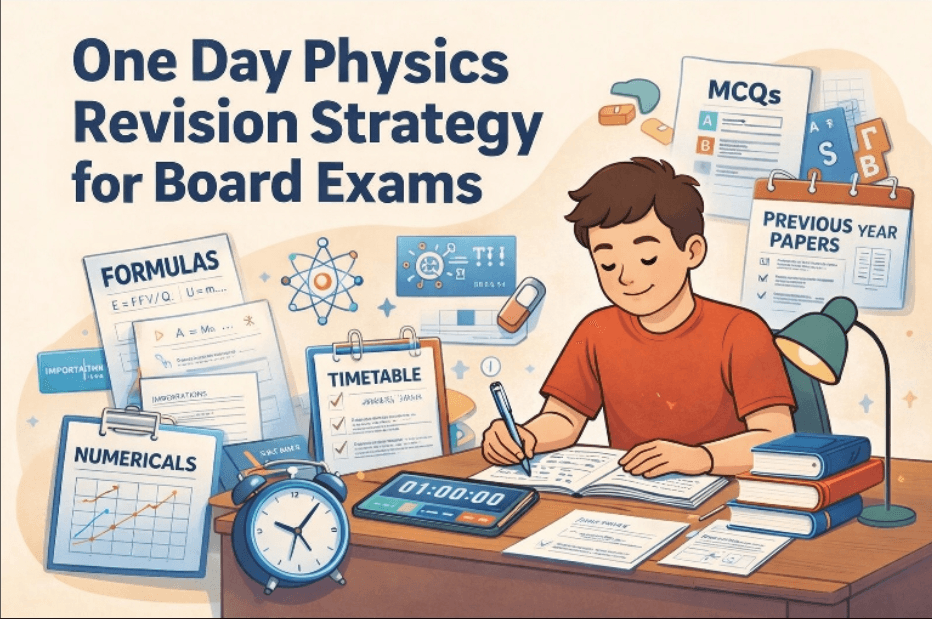
Preparing for a Physics board exam in just one day may sound stressful, but with the right revision strategy, you can still score high marks. Physics is not about reading everything again. It is about revising smartly, focusing on formulas, concepts, numericals, and previous year patterns. If you stay calm and follow a structured study plan, one day can be enough to boost your score significantly.
This guide will help you plan your last minute revision effectively and aim for 90+ marks.
Step 1: Start With a Quick Syllabus Scan (1 Hour)
Before diving in, quickly go through the entire syllabus. Mark:
- Chapters you are confident in
- Topics you find difficult
Focus more on high scoring and frequently asked units such as:
- Electrostatics
- Current Electricity
- Magnetism
- Optics
- Modern Physics
Do not waste time reading theory line by line. Just revise key points and definitions.
Step 2: Revise All Important Formulas (2–3 Hours)
Physics is incomplete without formulas. Create a rough sheet and write:
- All important formulas chapter-wise
- Units and dimensions
- Derived formulas
- Special cases and conditions
When you write formulas instead of just reading them, your memory retention increases. Revise:
- Formula applications in numericals
- Graph-based concepts
- Standard derivations
Most direct questions and numericals are formula-based, so this step is crucial.
Step 3: Practice Important Numericals (3 Hours)
After formulas, shift to numericals. Focus on:
- Previous year papers
- NCERT examples
- Frequently repeated questions
- Important questions marked by teachers
Solve at least 2–3 numericals from each major chapter. While solving:
- Write complete steps
- Mention formula used
- Check units properly
Board exams reward step marking, so presentation matters.
Step 4: Solve MCQs and Case-Based Questions (1–2 Hours)
Board exams now include MCQs and case-based questions. Practice:
- Assertion and Reason
- Case study based numericals
- Conceptual MCQs
These questions test understanding rather than memory. Avoid guessing. Revise concepts before answering.
Step 5: Attempt One Sample Paper (2–3 Hours)
Attempt at least one full sample paper in a proper exam-like setting:
- Set a timer
- Do not check answers in between
- Follow proper answer writing format
After completing, analyze:
- Weak areas
- Time management issues
- Silly mistakes
This gives you confidence before the actual exam.
Smart Time Table for One Day Revision
Here is a simple structure you can follow:
Morning
1 hour syllabus scan
2 hours formula revision
Afternoon
3 hours numericals practice
1 hour break and light revision
Evening
2 hours sample paper
1 hour mistake analysis
Night
Quick revision of weak topics and formulas
Sleep properly. Do not sacrifice sleep before the exam.
How to Score 90+ in Physics in One Day
Scoring 90+ is possible if you:
- Focus on high weightage chapters
- Revise formulas thoroughly
- Practice previous year papers
- Avoid learning new topics at the last moment
- Write answers neatly with proper steps
Remember, clarity of concepts/1%3A_The_Basics_of_Physics/1.1%3A_The_Basics_of_Physics) matters more than mugging up theory.
Common Mistakes to Avoid
- Studying new chapters one night before exam
- Ignoring derivations
- Skipping diagrams
- Not practicing numericals
- Panic revision without a plan
Stay confident and avoid distractions.
FAQs
1.What is the best way to revise physics exam in 1 day?
Ans. The best way is to divide your day into formula revision, numericals practice, and one full sample paper. Focus on high weightage topics and previous year papers instead of re-reading the entire textbook.
2.How to score 90+ in physics in one day?
Ans. Revise all important formulas, solve repeated board questions, practice step-wise numericals, and attempt one timed sample paper. Presentation and clarity can significantly improve your marks.
3.How many hours should I study Physics in one day before boards?
Ans. Ideally, 8–10 focused hours with proper breaks are enough for effective one-day revision. Prioritize formulas, numericals, and previous year questions.
4.Should I read the full NCERT in one day?
Ans..No. Instead of reading everything, revise important concepts, examples, derivations, and back-exercise questions from high weightage chapters.
5.Are previous year question papers enough for last-minute revision?
Ans. They are extremely helpful because many questions follow similar patterns. However, revise formulas and concepts along with solving previous year papers.