Is AI a Subject From Class 3 CBSE? What Parents Should Know
CBSE's AI and computational thinking lessons start from Class 3 in 2026-27, taught inside Maths and EVS rather than as a separate subject. Here is what your child will learn, what they will not, and what parents can do at home in 10 minutes a day.
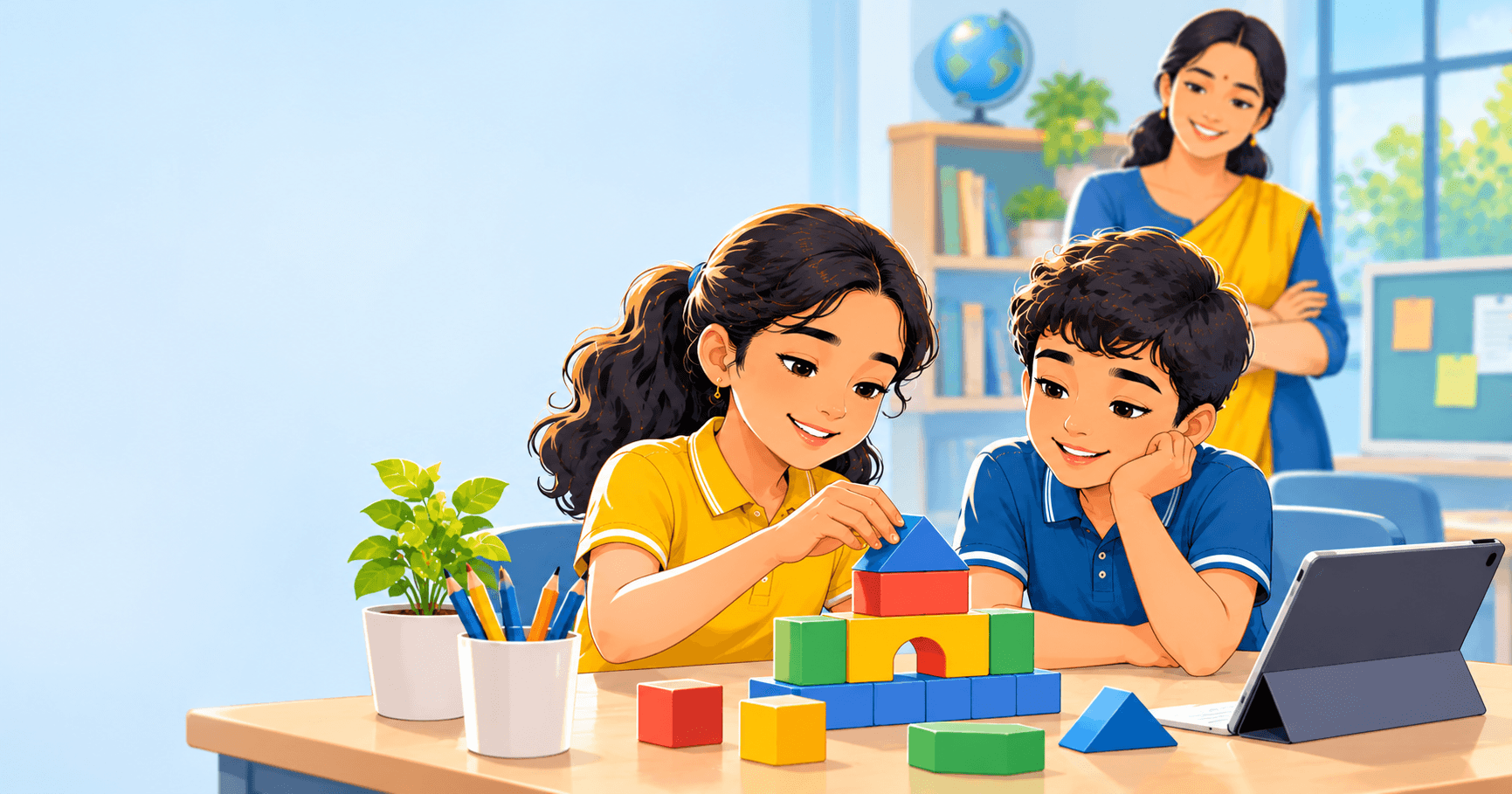
No, AI is not a separate subject from Class 3 in CBSE. From the 2026-27 session, CBSE schools teach computational thinking (CT) and AI inside existing subjects. For Classes 3 to 5, that means Maths and Environmental Studies (EVS), with about 50 hours a year suggested in the curriculum.
If you searched for the AI subject from Class 3 CBSE, you are probably worried. Maybe a relative said your child must learn coding, or a school notice used the word 'subject'. This guide explains what has been decided, what is still a plan, and what it means for your child.
Is AI a Subject From Class 3 CBSE?
The short answer is no. AI is taught as a part of Maths and EVS. It does not come with its own textbook, its own marks or its own exam at this level.
| Stage | Session | Suggested time | How it is taught |
|---|---|---|---|
| Classes 3 to 5 | 2026-27 | About 50 hours a year | Inside Maths and EVS, with extra thinking questions and worksheets |
| Classes 6 to 8 | 2026-27 | About 100 hours a year | Inside existing subjects, with AI basics and small projects |
The full plan is in CBSE's curriculum document for Computational Thinking and AI. The hours are suggestions, and your child's school sets its own timetable.
What has been announced
The Union Education Minister launched CBSE's Computational Thinking and Artificial Intelligence curriculum for Classes 3 to 8 on 1 April 2026, as shown in the launch press release. The official circular, Acad-15/2026, is also dated 1 April 2026.
This is notified and in force from the 2026-27 session. In plain words, the framework is ready, it started this year, and it is built into the subjects your child already studies. CBSE has also released teacher handbooks and student resource books to help schools run it.
There is no board exam for Classes 3 to 8. Learning is checked through class work, written thinking tests, hands-on activities and the teacher's own observation.
Updates are also posted on the CBSE website and the Ministry of Education website.
What comes later
Here is what is final, and what is still a plan:
- Final (in force): CT and AI for Classes 3 to 8 from 2026-27.
- Changed: CBSE Circular Acad-70/2026, dated 29 October 2026, says the CT and AI modules are not part of the Class 9 scheme for 2026-27. They are also not part of Class 10 for the same students in 2027-28.
- Planned, not notified: CT and AI becoming compulsory in Class 9 from 2027-28, with the first board assessment planned for 2029.
- Senior classes: In a reply in Parliament on 5 August 2026, the Ministry said the Class 9 to 12 curriculum for AI and allied subjects has been finalised. AI is also available as an optional skill subject in these classes (Subject Codes 417 and 843).
Here is what this means for a child's timeline. A child in Class 6 in 2026-27 reaches Class 10 in 2030-31. A child in Class 8 in 2026-27 reaches Class 10 in 2028-29, the session linked to the planned 2029 board assessment.
What a Class 3 child will actually learn, and what they will not
Your child is not being taught to code neural networks, or to build an AI model. At Class 3, the work looks more like puzzles, patterns and putting things in order. Here are the main areas, with examples:
- Patterns: finding what comes next in a row of shapes, symbols or numbers.
- Instructions and sequences: putting steps in the right order, and breaking a big task like packing a school bag into small steps.
- Possible choices: listing all the ways to pick two friends from five for a team.
- Simple computer skills: parts of a computer, saving and finding a file, basic internet safety, and block-based activities where children drag blocks to make a character move. This is not typing code.
- Data sense: reading a simple chart or picture, such as which fruit sold the most in a shop.
- Human or machine answers: learning to ask whether an answer came from a person or a machine, and how you know. This example is our own illustration of the idea, not a line from the official text.
From Class 6, children also look at digital footprints, bias, privacy and fairness in AI systems.
What they will not learn at this stage: AI model building, neural network maths, or a full programming language.
Why the government is doing this now
The official reason is to build early thinking skills such as logical reasoning, problem solving and pattern recognition. It follows NEP 2020 and the National Curriculum Framework for School Education, 2023.
AI is expected to change some jobs, mainly in India's tech sector. A NITI Aayog roadmap from October 2025 gave job estimates, and different reports quote different numbers, so treat any single figure with care.
What this does not mean for your child's career
Your child does not have to become an engineer or a coder because of this. AI at school is a literacy, like reading and basic numbers. It is not a stream.
Think of it like learning to use a calculator well. It helps your child think clearly, but it does not choose a career for them. Streams after Class 10 are still chosen on interests, strengths and marks.
If you are wondering when to start thinking about careers, our guide to career counselling for Class 8 and 9 explains the early steps. For the skills that keep their value, read future-proof skills that AI cannot replace. For guidance on supporting your child's choices, see how parents can support their children's career choices.
Five things a parent can do at home (10 minutes a day)
You do not need any technical skill for these. Pick one, keep it to about 10 minutes, and make it a conversation, not a test.
- Ask 'How did you work that out?' Use this during homework. When your child explains the steps in their own words, they are practising logical thinking.
- Play 'What comes next?' Line up bangles, buttons or small vegetables in a pattern, such as two red, one green, two red. Ask your child to continue it and tell you the rule.
- Give steps, then follow them exactly. Ask your child to write the steps for making tea or packing a school bag. Then follow the steps word for word, so a missing step shows up. Children usually find this funny, and it teaches them to order things.
- Check a machine's answer together. Ask a voice assistant one simple question about something your child knows well, such as a local festival. Then ask, 'How can we check this is right?' Sit next to your child while you do this.
- Read one chart together each day. Use a cricket scorecard, a weather forecast, a bus timetable or your electricity bill. Ask, 'Which is the biggest number? What changed since last month?'
The real risk: AI used to finish homework instead of to think
The bigger risk for children is not the lesson itself. It is using AI to finish homework, so the child never learns to think it through.
Signs to watch for:
- The answer is far better than your child's usual work, and uses words they never use in class.
- Your child cannot explain a line when you ask, 'Tell me in your own words.'
- The answer skips the working, or includes facts the class has not covered.
- The writing suddenly sounds nothing like your child.
What helps:
- Set one clear rule: AI can give hints, not final answers.
- Ask your child to write the first draft by hand, then use AI only to check it, and explain what they changed.
For more ideas on home habits, read our article on preparing children for the AI era.
Frequently Asked Questions
Is AI a separate subject for Class 3 in CBSE?
No. From the 2026-27 session, CBSE teaches computational thinking and AI for Classes 3 to 5 inside Maths and Environmental Studies (EVS). There is no separate textbook, no separate marks and no board exam at this stage. The curriculum suggests about 50 hours a year for these classes.
Will my child learn coding in Class 3?
Your child will not write code in Class 3. The work is mostly puzzles, patterns, putting steps in order and simple computer skills. Some lessons use block-based tools, where children drag coloured blocks to make a character move. That builds step-by-step thinking, and it is not programming.
Is there a board exam for AI in Classes 3 to 8?
No. CBSE does not hold a board exam for Classes 3 to 8. Learning in this area is checked through class work, written thinking tests, hands-on activities and the teacher's observation. The first planned AI board assessment is for Class 10, around 2029, and it is not yet notified.
When does AI become a board subject for CBSE students?
It is planned, not final. The plan is compulsory CT and AI in Class 9 from 2027-28, with the first board assessment planned for 2029. CBSE Circular Acad-70/2026, dated 29 October 2026, has already taken these modules out of the current Class 9 scheme, so ask your child's school for the latest timetable.
Will AI replace jobs for my child?
Nobody can say exactly which jobs AI will change. Reports point to change mainly in India's tech sector. Children who think clearly, solve problems and use technology well are better placed for any career. AI lessons at school build these habits, but they do not guarantee a job. Your child's interests and strengths still matter most.
Conclusion
AI from Class 3 is part of Maths and EVS from 2026-27, it is a way of thinking rather than a stream, and the Class 9 and board parts are still plans. If you are still confused about what this means for your child, you can take our free Career Suitability Test and connect with Infigon Futures to talk to a career expert.
Before you decide: two free 2-minute checks
- 2 min · freeAre your skills safe from AI?AI will replace people who only do work a machine can do. Answer 10 quick questions to see your score and what to work on.Check my skills
- 1 min · freeWhen will you earn your dream salary?Pick a career and the monthly salary you want. We show at what age people in that career usually earn that much, or if most never do.Check my salary