
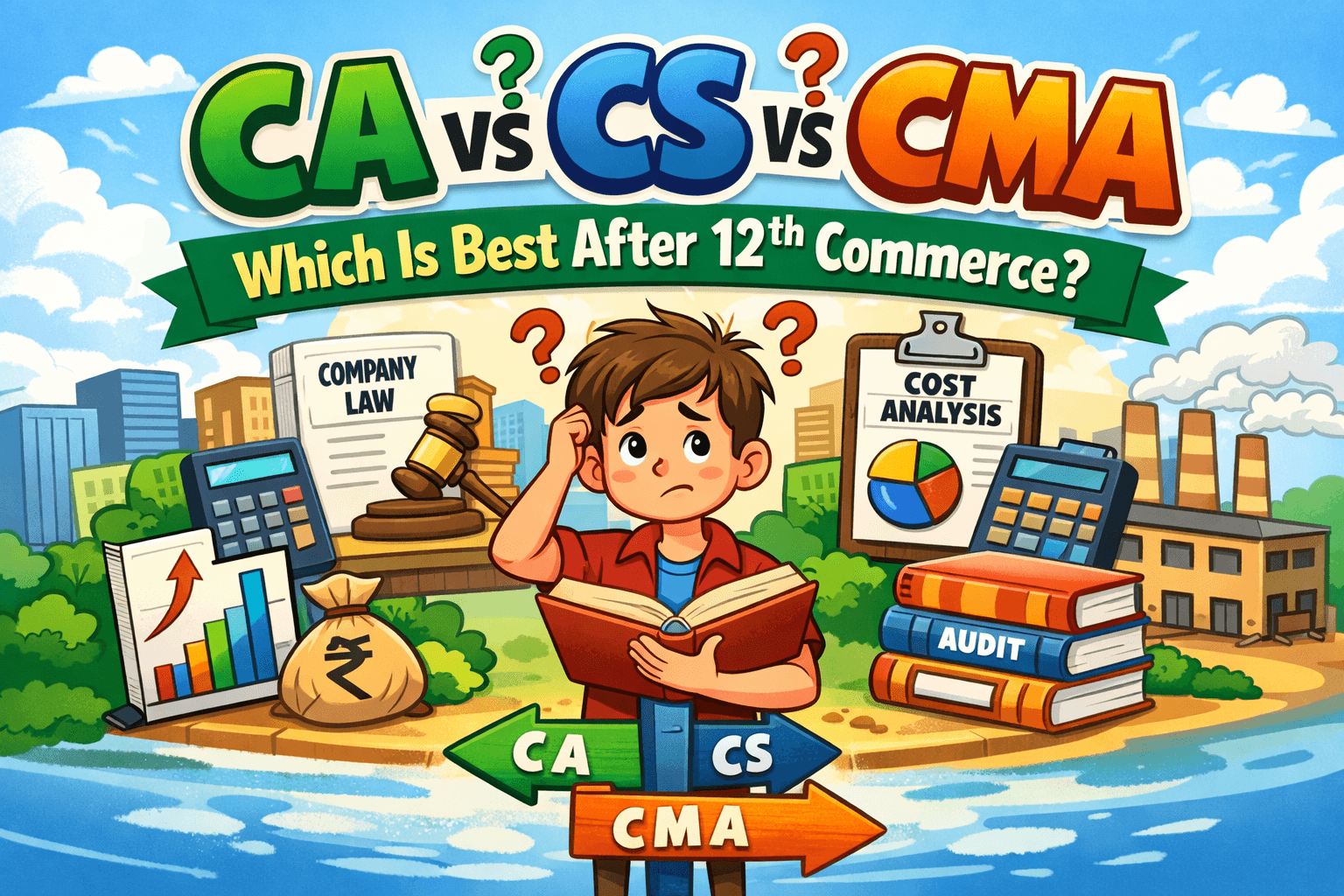
Choosing the right career path after the 12th grade is a huge decision, especially if you are from the Commerce stream. You probably hear people talking about being a Chartered Accountant or a Company Secretary all the time, but it can get confusing. Should you go for the CA course or consider becoming a Cost Accountant? Each of these Professional courses after 12th Commerce has its own vibe and career path. Some focus on numbers and taxes, while others are all about laws and company rules. It is not just about which one is famous, but about what fits your personality. If you love deep analysis, one might be better, but if you like managing people and legal stuff, another might be the winner. Let’s break down the CA vs CS vs CMA debate so you can figure out which Professional course is actually the Best course after 12th Commerce for your future.
Choosing Your Path: CA vs CS vs CMA
Picking a career is like picking a vibe for the next 40 years of your life. In the world of Commerce, the three big players are CA, CS, and CMA. While they all sound similar because they deal with business, their daily work is very different. An Accountant might focus on the past, but these professionals look at the future of a business.
What is Chartered Accountancy (CA)?
The CA path is usually the first thing people think of. It is handled by the ICAI and is known for being quite a challenge. If you are into Accounting, auditing, and handling big taxes, this is where you belong.
- CA course details involve three main levels: Foundation, Intermediate, and Final.
- You have to complete a mandatory articleship (practical training).
- The focus is heavily on taxation and auditing.
- It is considered a very prestigious Certification in India.
- You can check if AI might change things for CAs in the coming years.
Understanding the Company Secretary (CS) Role
If you find law more interesting than purely crunching numbers, then becoming a Company Secretary might be your thing. This course is governed by the ICSI. You are basically the bridge between a company and the legal world.
- CS course details focus on corporate laws and governance.
- You ensure the company follows all the rules set by the government.
- The work involves a lot of reading and understanding legal documents.
- It is a great Career for those who like communication and administration.
- The breakdown of a CS salary shows it is a very stable and high-paying field.
The World of Cost and Management Accounting (CMA)
A Cost Accountant is like a doctor for a company’s expenses. They analyze where the money goes and how to save it. This is managed by the ICMAI. It is a very practical course and is gaining a lot of popularity.
- CMA course details highlight cost management and strategic planning.
- You help companies decide the price of their products.
- The CMA course is great if you want to work in the manufacturing or service sectors.
- The expected salary for CMAs is growing fast as industries expand.
Comparing the Three Big Courses
To make it easy, I have put together a few tables so you can see the differences at a glance.
Core Focus and Difficulty
| Feature | CA | CS | CMA |
|---|---|---|---|
| Primary Focus | Auditing and Accounting | Law and Governance | Cost and Finance |
| Difficulty Level | Very High | High | Moderate to High |
| Duration | 4.5 to 5 Years | 3 to 4 Years | 3 to 4 Years |
| Best For | Number crunchers | Law enthusiasts | Strategy lovers |
Job Roles and Opportunities
Finding Jobs is the main goal, right? Here is what you might do in each field:
| Profession | Common Job Roles |
|---|---|
| CA | Auditor, Tax Consultant, Investment Banker |
| CS | Compliance Officer, Legal Advisor, Board Assistant |
| CMA | Cost Manager, Budget Analyst, Finance Controller |
Many people wonder why some graduates struggle to find work, and often it is because they don't pick a specialized path like these.
Salary and Growth
The salary is a big factor for everyone. While it varies based on your skills, here is a general idea:
| Course | Starting Salary (Approx.) | Growth Potential |
|---|---|---|
| CA | 7 to 10 Lakhs | Very High |
| CS | 5 to 8 Lakhs | High |
| CMA | 5 to 9 Lakhs | High |
Key Differences in Skills
Each of these Courses requires a different mindset.
- CA needs extreme patience and analytical skills.
- CS needs a strong memory for laws and great drafting skills.
- CMA needs a practical approach to business operations and numbers.
- It is honestly about what you enjoy doing for 8 hours a day. If you like solving puzzles with money, go for CA. If you like rules and ensuring things are done the "right" way, CS is great. If you like making things efficient and saving costs, CMA is your best bet.
FAQs
Q1. Which is best, CA, CMA, or CS?
Ans. There is no single "best" one. It depends on your interest. If you love auditing and taxes, CA is the leader. If law and corporate compliance excite you, then CS is the way to go. For those into cost management and business strategy, CMA is the top choice.
Q2. Which profession has more scope: CA, CMA or CS?
Ans. All three have massive scope. However, CA has a slightly wider reach because every business needs an Accountant and an auditor. CS is mandatory for larger companies, ensuring legal safety. CMA is essential for manufacturing and large-scale service industries to manage their budgets.
Q3. What should I pursue after my graduation? CA, CMA or CS?
Ans. You can actually start these right after 12th! But if you have finished graduation, you can get direct entry into the Intermediate levels, saving you time. Choose based on which subjects you enjoyed most during your B.Com or BBA.
Q4. Which course is best CA, CMA (ICWA) or CS?
Ans. Again, it is about your goal. CA is the most recognized in the field of Finance. CS is the most specialized for legal roles. CMA is the most industry-focused.
Q5. Can I do two of these courses together?
Ans. Yes, many students do CA with CS or CMA with CA. It is very hard work, but it makes your resume look amazing for high-level Finance positions.