
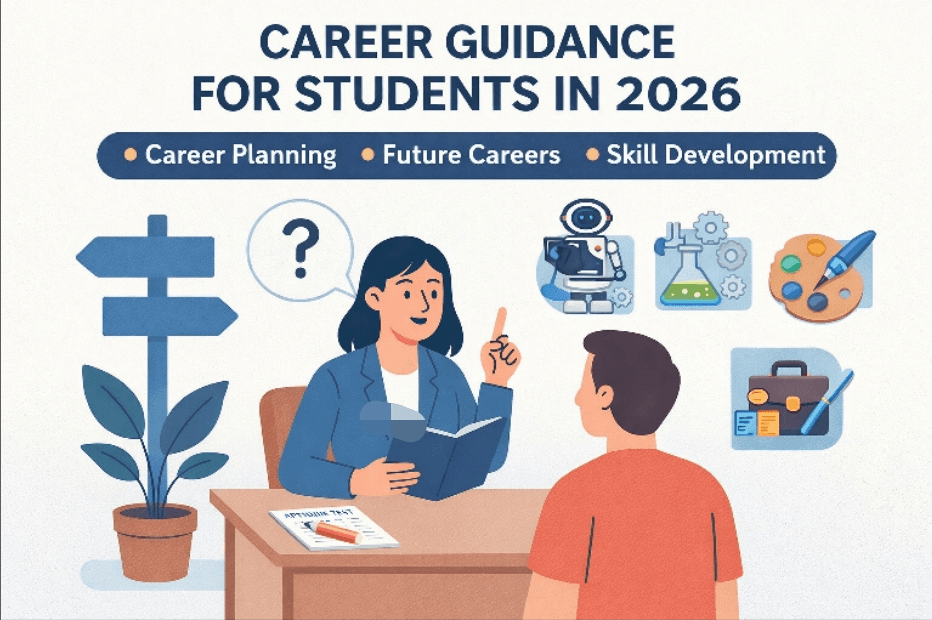
Choosing the right career in 2026 is more than just picking a degree after 10th or 12th. With Artificial Intelligence transforming industries, new-age jobs emerging every year, and online certification courses opening global opportunities, students today have more options than ever before.
But more options also mean more confusion.
If you are wondering how to choose the right career after 10th or 12th, this complete guide will help you make a smart, confident, and future-ready decision.
Why Career Planning Matters More in 2026
The job market is changing rapidly. Fields like Artificial Intelligence, Data Science, Digital Marketing, FinTech, Sustainable Energy, and Healthcare Technology are growing fast. At the same time, traditional careers are evolving with technology.
Career planning helps you:
- Avoid random degree choices
- Save time and money
- Identify high paying jobs aligned with your strengths
- Focus on skill development courses early
- Prepare for future careers instead of outdated roles
A planned decision today can shape your next 30–40 years.
Step 1: Understand Yourself First
Before searching for career options after 12th science, commerce, or arts, ask yourself:
- What subjects do I enjoy?
- What activities make me feel confident?
- Do I prefer creative, analytical, technical, or people-oriented work?
- Do I want job stability, entrepreneurship, or flexibility?
Self-awareness is the foundation of career choice. Without it, even the best career options may feel wrong later.
Step 2: Explore Career Options After 10th and 12th
Let’s break it down stream-wise.
Career Options After 12th Science
If you have a science background, your options are broad:
- Engineering (AI, Robotics, Computer Science, Mechanical, Civil)
- Medical (MBBS, BDS, Nursing, Pharmacy)
- Biotechnology
- Data Science
- Environmental Science
- Aviation
- Research & Development
Science students often enter high paying jobs, especially in technology and healthcare sectors.
Career Options After 12th Commerce
Commerce students can choose from:
- Chartered Accountancy (CA)
- Company Secretary (CS)
- BBA / MBA
- Banking & Finance
- Investment Analysis
- Digital Business
- Entrepreneurship
With FinTech and digital finance rising in 2026, commerce careers are becoming more dynamic than ever.
Career Options After 12th Arts
Arts students have strong career growth opportunities in:
- Psychology
- Civil Services
- Design (Graphic, Fashion, UI/UX)
- Journalism & Media
- Law
- Social Work
- International Relations
Creative and communication-based careers are thriving in the digital era.
Step 3: Research Future Careers, Not Just Popular Ones
Many students choose careers based on trends or peer pressure. Instead, research:
- Industry growth rate
- Average salary
- Required qualifications
- Internship opportunities
- Global demand
For example, Artificial Intelligence is not just a trend. It is transforming healthcare, finance, marketing, and education. Similarly, sustainability-focused careers are expanding due to environmental concerns.
Always look 5–10 years ahead.
Step 4: Focus on Skill Development
Degrees alone are not enough in 2026.
Recruiters now value:
- Practical skills
- Communication
- Problem-solving ability
- Internship experience
- Certifications
Online certification courses in AI, digital marketing, finance, coding, and design can strengthen your resume early.
Even if you are in Class 10 or 12, you can start job oriented courses to explore your interests.
Step 5: Take Internships Seriously
Internship opportunities help you:
- Experience real work environments
- Understand if you truly like a field
- Build professional networks
- Improve your resume
Many students realize during internships that their initial career plan needs adjustment and that’s perfectly okay.
It’s better to discover early than regret later.
Step 6: Don’t Ignore Career Counseling
Professional career counseling can simplify confusion.
A good career counselor helps you:
- Identify your strengths
- Match your personality with suitable careers
- Understand academic pathways
- Avoid unrealistic expectations
Many students benefit from structured career guidance sessions before making final decisions.
Step 7: Take a Career Aptitude Test
A career aptitude test measures:
- Logical reasoning
- Personality traits
- Interest areas
- Learning style
These insights help you choose a career that fits both your abilities and preferences.
Aptitude testing removes emotional bias and brings clarity to decision-making.
Common Mistakes Students Make
Avoid these errors:
- Choosing a career because friends are choosing it
- Following only salary trends
- Ignoring personal interests
- Not researching properly
- Avoiding skill development
- Depending only on marks
Marks matter, but skills and clarity matter more.
How to Decide What Career Is Best for You
Here is a simple 5-point formula:
- Interest
- Strength
- Market demand
- Income potential
- Long-term growth
If a career checks at least 4 out of these 5 boxes, it’s worth serious consideration.
FAQs
1. How to choose the right career after 12th?
Ans. Start by identifying your interests and strengths, research future industry trends, take a career aptitude test, and seek professional career counseling if needed.
2. How can students choose the right career path after 12th?
Ans. Students should combine self-analysis, market research, internship exposure, and skill development courses before finalizing a decision.
3. How to decide what career is best for you?
Ans. Choose a career that matches your interest, strengths, industry demand, income potential, and long-term growth opportunities.
4. Is career counseling necessary after 10th or 12th?
Ans. Career counseling is not compulsory, but it is highly recommended. Professional guidance and psychometric assessments can help students avoid confusion, identify suitable career options, and make informed decisions based on strengths and interests.
5. Which careers will be in high demand in 2026?
Ans. Careers in Artificial Intelligence, Data Science, Healthcare, Digital Marketing, Cybersecurity, FinTech, Environmental Science, and Sustainable Energy are expected to see strong growth and high demand in 2026 and beyond.