
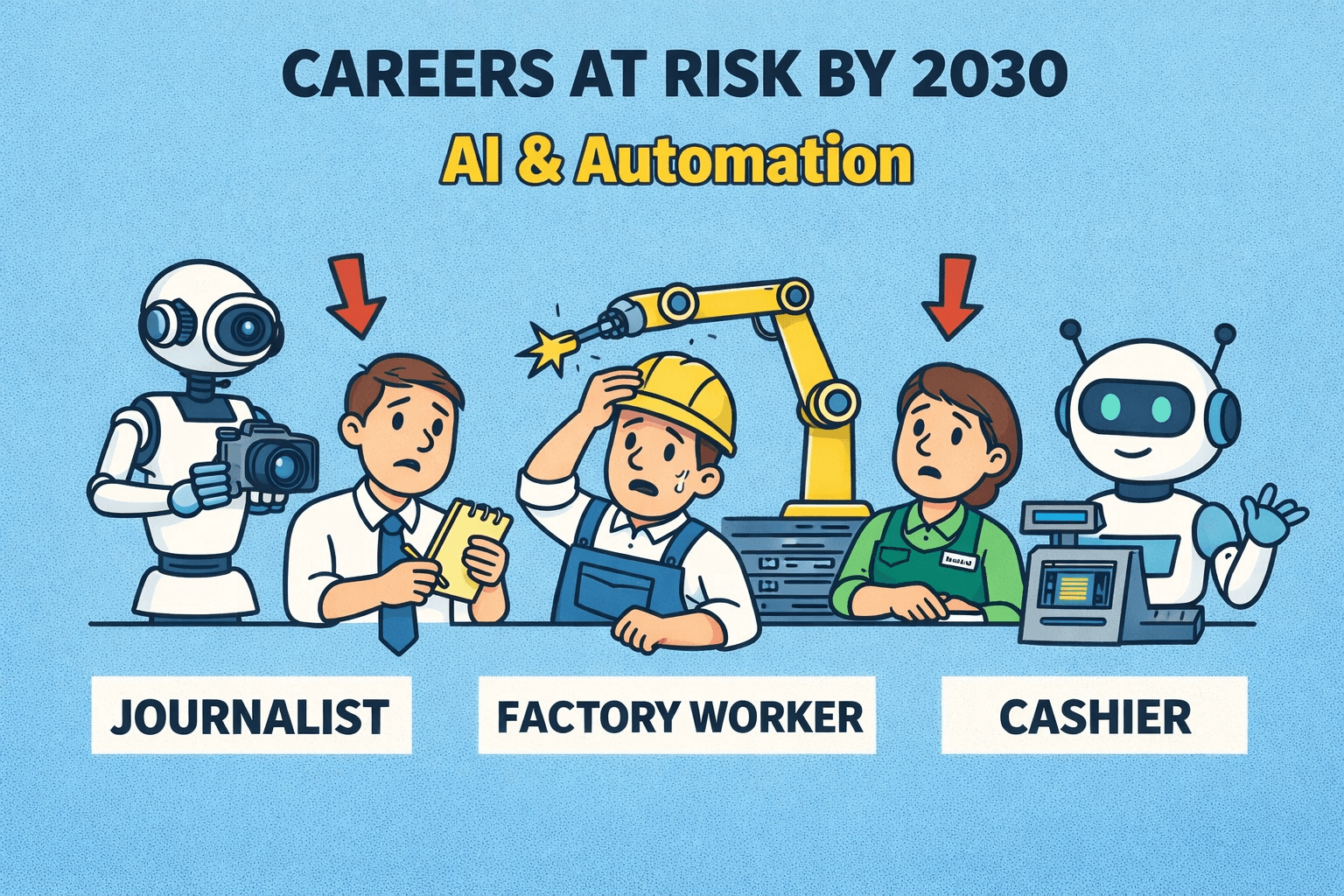
Artificial Intelligence and automation are no longer future concepts—they are already reshaping how industries work. From self-checkout machines to AI-powered customer support, technology is steadily replacing repetitive and predictable tasks. As we move closer to 2030, several traditional careers face serious disruption, while others may completely disappear. This doesn’t mean jobs are vanishing altogether—it means the nature of work is changing. Understanding which careers are at risk can help students and professionals make smarter, future-ready career choices.
Why AI Is Replacing Certain Jobs
AI and automation thrive in roles that involve:
- Repetitive tasks
- Rule-based decision-making
- Minimal human judgment
- Limited creativity or emotional intelligence
Machines don’t get tired, don’t ask for raises, and can work 24/7. This makes them attractive for industries focused on efficiency and cost-cutting.
Careers Most Likely to Disappear by 2030
1. Data Entry Operators
Data entry is one of the most vulnerable careers. AI systems can now process, organize, and verify massive datasets within seconds, reducing the need for human intervention.
2. Telemarketers
AI-powered voice bots and chatbots are replacing human telemarketers. These bots can handle thousands of calls simultaneously and personalize scripts using customer data.
3. Cashiers
With self-checkout kiosks, digital payments, and cashier-less stores, the demand for traditional cashiers is declining rapidly, especially in urban areas.
4. Basic Customer Support Executives
AI chatbots and virtual assistants can answer FAQs, process complaints, and provide support without human involvement, making entry-level support roles less relevant.
5. Manufacturing Assembly Line Workers
Robots equipped with AI can assemble products faster and more accurately than humans, leading to reduced demand for manual labor in factories.
6. Travel Agents
Online booking platforms and AI-based travel planners have made trip planning easier and cheaper, minimizing the role of traditional travel agents.
7. Bank Clerks
Routine banking tasks like passbook updates, withdrawals, and deposits are increasingly handled through apps, ATMs, and AI-driven systems.
Jobs That May Become Invalid After 2030
Some jobs won’t vanish overnight but will slowly lose relevance:
- Typists and transcriptionists
- Toll booth operators
- Traditional proofreaders (for basic content)
- Warehouse pickers (due to robotics)
These roles rely heavily on predictable patterns—something AI excels at.
Jobs That Will Go Extinct in the Next 5 Years
In the short term, the following roles are already shrinking:
- Call center agents (basic queries)
- Ticket booking agents
- Meter readers
- Front-desk clerks in hotels
Automation and self-service systems are accelerating this shift.
Careers That Will Be Safest From AI Automation by 2035
Not all jobs are at risk. Careers that require human creativity, emotional intelligence, complex judgment, and adaptability will remain in demand. Some of the safest roles include:
- Doctors, nurses, and mental health professionals
- Teachers and education specialists
- Psychologists and counselors
- AI engineers and data scientists
- Cybersecurity experts
- Creative professionals (designers, writers, filmmakers)
- Strategic managers and leaders.
AI can assist these professionals—but cannot replace the human element involved.
What This Means for Students and Young Professionals
The biggest mistake today is choosing a career based only on current trends. Instead, future-ready careers should focus on:
- Problem-solving
- Creativity
- Communication skills
- Emotional intelligence
- Tech adaptability
Upskilling is no longer optional—it’s essential.
FAQs
1. Which jobs are most at risk due to AI automation?
Ans. Jobs involving repetitive tasks, such as data entry, telemarketing, cashier roles, and basic customer support, are at the highest risk due to AI and automation.
2. What are the jobs that will become invalid after 2030?
Ans. Roles like typists, manual record keepers, toll booth operators, and basic clerical jobs may become irrelevant as automation advances.
3. Which jobs will be the safest from AI automation by 2035?
Ans. Healthcare professionals, educators, psychologists, creative professionals, and AI specialists are among the safest due to their reliance on human judgment and creativity.
4. Which jobs will go extinct in the next 5 years?
Ans. Basic call center roles, ticket booking agents, meter readers, and front-desk clerks are already declining and may disappear slowly.
5. Can AI completely replace humans in the workforce?
Ans. No, AI cannot fully replace humans. While it can automate repetitive and rule-based tasks, human skills like creativity, empathy, ethical judgment, and complex decision-making will always remain essential in the workforce.