
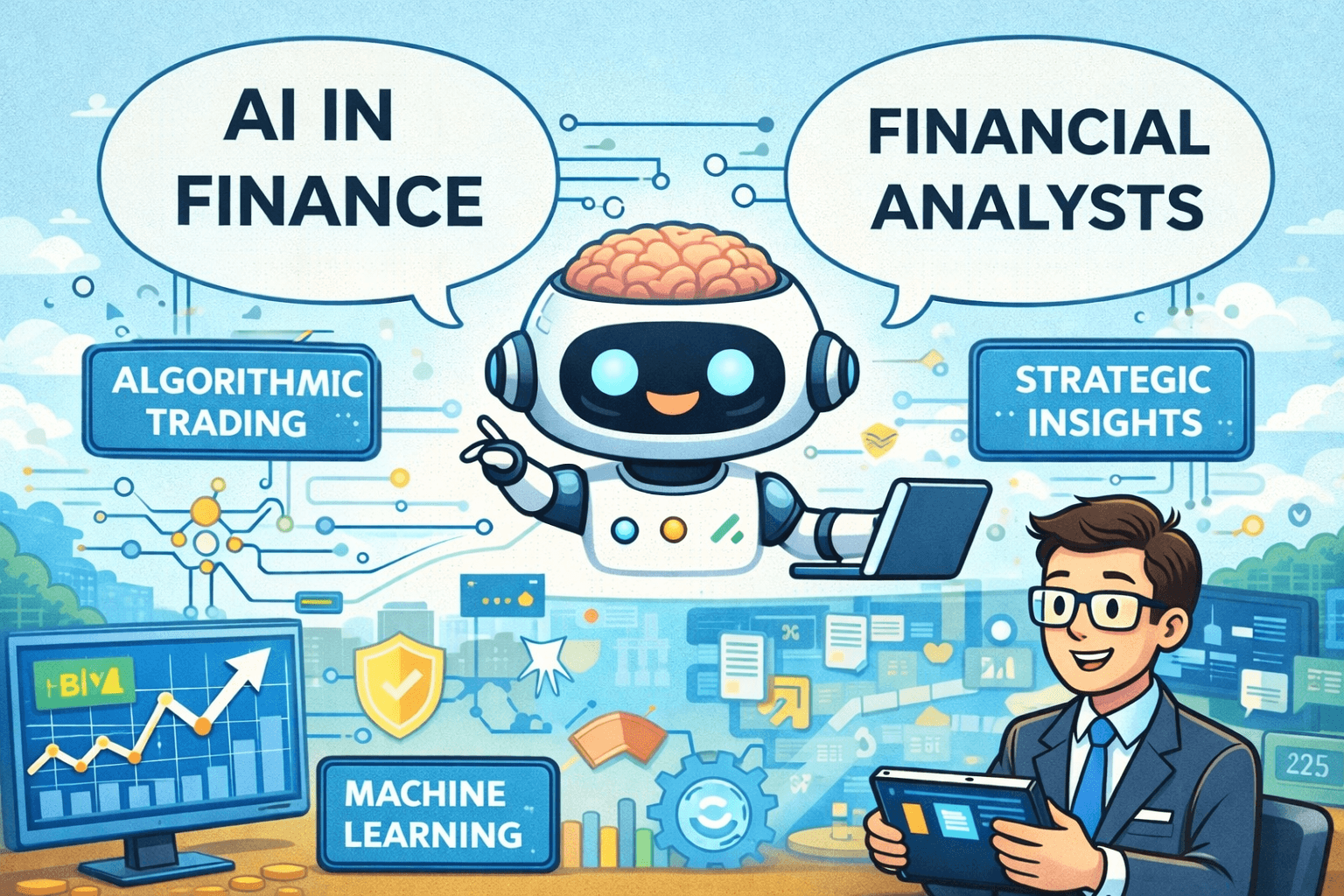
Artificial Intelligence (Ai) is rapidly transforming the word of finance, reshaping how businesses, banks, and investment firms operate. From automation to advanced data analytics, AI is redefining the traditional role of financial analysts and pushing the profession toward more strategic and insight-driven work.
The Traditional Role of a Financial Analyst
- Traditionally, a financial analyst focused on:
- Financial reporting and accounting analysis
- Budgeting and forecasting
- Investment evaluation
- Market and economic trend analysis
Much of this work relied heavily on manual data collection, spreadsheets, and historical analysis. While effective, it was time-consuming and prone to human error.
AI in Finance: A Game Changer
AI in finance leverages technologies such as machine learning, algorithms, and big data to analyze massive datasets at high speed. This allows financial analysts to move beyond number-crunching and focus on higher-value decision-making.
Key benefits include:
- Faster data processing
- Improved accuracy
- Real-time financial insights
- Predictive and prescriptive analytics
Machine Learning in Finance and Forecasting
Machine learning in finance has significantly improved financial forecasting. AI models learn from historical and real-time data to:
- Predict revenue trends
- Forecast market movements
- Identify investment opportunities
- Detect anomalies in financial data
This enables analysts to make proactive decisions rather than reactive ones.
Data Analytics for Finance and Investment Decisions
Advanced data analytics for finance allows analysts to analyze structured and unstructured data such as:
- Market data
- Customer behavior
- News and social sentiment
In investment and banking, AI-driven analytics help uncover patterns that humans might miss, improving portfolio management and financial strategy.
Risk Management AI and Fraud Detection
One of the most impactful uses of AI is in risk management. Risk management AI systems can:
- Assess credit risk
- Detect fraud in real time
- Monitor compliance issues
- Model economic downturn scenarios
This has become especially important in today’s volatile economy, where quick risk assessment is critical.
Algorithmic Trading and Automation
Algorithmic trading uses AI-powered models to execute trades at optimal times with minimal human intervention. This level of automation improves efficiency, reduces emotional bias, and enhances profitability in high-frequency trading environments.
How the Role of Financial Analysts Is Evolving
With artificial intelligence in finance, financial analysts are now expected to:
- Interpret AI-generated insights
- Provide strategic business recommendations
- Collaborate with data and technology teams
- Understand AI models and analytics outputs
The role is shifting from data preparation to strategic financial advisory.
Skills Financial Analysts Need in the AI Era
To stay relevant, modern financial analysts should develop skills in:
- AI and machine learning basics
- Financial analytics tools
- Business and strategic thinking
- Technology-driven decision-making
FAQs
1. How is AI changing the role of financial analysts?
Ans. AI automates data processing and forecasting, allowing financial analysts to focus more on strategy, insights, and decision-making.
2. What is the role of machine learning in finance?
Ans. Machine learning helps analyze large financial datasets to predict trends, detect fraud, and improve investment and risk management decisions.
3. Does AI replace financial analysts in banking and investment firms?
Ans. No, AI supports analysts by enhancing accuracy and efficiency, while humans interpret insights and make strategic judgments.
4. How does AI improve risk management in finance?
Ans. Risk management AI identifies patterns, assesses credit and market risks, and detects fraud in real time using advanced analytics.
5. What skills should financial analysts learn in the AI era?
Ans. Analysts should understand data analytics, AI fundamentals, financial technology tools, and strategic business analysis.