
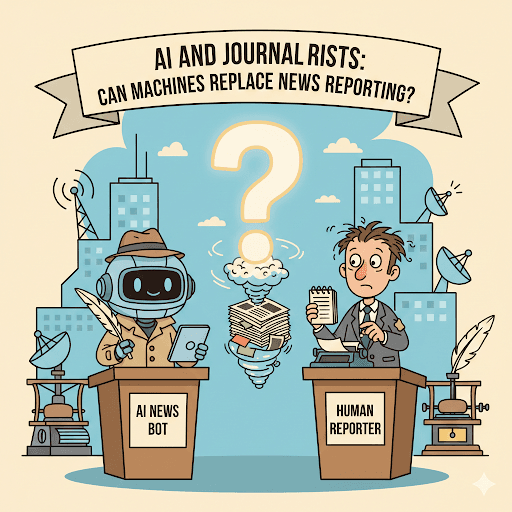
Artificial Intelligence is rapidly entering newsrooms across the world. From writing short news updates to analysing large datasets, AI tools are changing how journalism works. This has raised an important question for journalists, writers, and readers alike — can machines replace news reporting, or will human journalists always be necessary?
Let’s look at the reality, not the hype.
How AI Is Already Used in Journalism
AI is not new to journalism. Many media houses already use it for tasks like:
- Writing financial reports and sports scores
- Analysing election data and trends
- Transcribing interviews
- Detecting fake news and misinformation
- Personalising news for readers
AI works best when the task is repetitive, data-heavy, and time-sensitive. For example, stock market updates or weather reports can be produced faster and with fewer errors using algorithms.
However, this does not mean AI understands news the way humans do.
Will AI Replace Journalists in the Future?
The short answer is no but it will change journalism significantly.
AI can assist journalists, but replacing them entirely is unlikely. News reporting is not just about writing sentences. It involves judgment, ethics, emotions, and accountability — areas where machines fall short.
Journalists ask difficult questions, verify sources, understand social context, and make moral decisions. AI lacks real-world experience and human values, which are essential in journalism.
Can AI Replace Investigative Journalists?
Investigative journalism is one of the strongest examples of why humans still matter.
Investigative reporters:
- Build trust with sources
- Uncover corruption and abuse of power
- Interpret hidden meanings and motives
- Take ethical risks and responsibility
AI can analyse thousands of documents quickly, which helps investigations. But it cannot conduct sensitive interviews, protect whistleblowers, or challenge authority with intent and courage.
So while AI can support investigations, it cannot replace investigative journalists.
Will AI Replace All Types of Journalists and Writers?
Not all journalism is the same.
AI is more likely to impact:
- Basic reporting
- Data-driven content
- Routine news updates
But roles that require creativity, storytelling, opinion, and deep analysis will remain human-driven. Feature writers, editors, political analysts, and ground reporters bring perspectives that machines cannot replicate.
In fact, journalists who learn to work with AI tools may have better career opportunities in the future.
Could AI Take Over the Media Industry?
AI will not take over the media industry, but it will reshape it.
The future newsroom will likely include:
- Journalists using AI for research and data analysis
- Faster content creation with human editing
- Stronger focus on ethics and credibility
New roles like AI editors and data journalists
The biggest risk is not AI itself, but misuse of AI, such as spreading misinformation, deepfakes, and biased content. This makes responsible journalism more important than ever.
Ethics and Responsibility in AI Journalism
AI systems learn from existing data, which can contain bias. Without human supervision, AI-generated news can be misleading or unethical.
This is why human editors are essential to:
- Verify facts
- Maintain journalistic integrity
- Ensure accountability
- Protect democratic values
- Ethics in journalism cannot be automated.
FAQs
Q1: Can AI fully replace human news reporters in 2026?
Ans. No. While AI can automate "commodity news" (like stock market updates, sports scores, and weather), it cannot replace the human elements of investigative journalism, such as whistle-blower interviews, ethical judgment, and on-the-ground emotional reporting.
Q2: What are "AI News Anchors," and are they being used?
Ans. AI News Anchors are hyper-realistic digital avatars powered by generative AI. By 2026, many global newsrooms use them for 24/7 news cycles and multilingual broadcasts. However, they lack the ability to handle unscripted, breaking news situations where live improvisation is required.
Q3: Is AI-generated news accurate?
Ans. Not always. AI models are prone to "hallucinations"—generating facts that sound plausible but are entirely false. In 2026, the industry standard is to have a "human-in-the-loop" to fact-check every AI-generated claim before publication to maintain credibility.
Q4: How does AI help journalists rather than replace them?
Ans. AI acts as a powerful assistant. It can transcribe hours of interviews in minutes, analyze massive datasets (like the Panama Papers) to find hidden patterns, and translate stories into dozens of languages instantly, allowing journalists to focus on deep-dive storytelling.
Q5: Can AI write creative opinion pieces or editorials?
Ans. AI can mimic the style of an editorial, but it lacks personal lived experience and a moral compass. An AI doesn't have "beliefs" or "values," so while it can synthesize existing opinions, it cannot provide the original, provocative thought that defines great columnists.
Q6: Does the rise of AI mean fewer jobs for journalism students?
Ans. The job market is shifting. While entry-level "copy-pasting" or "rewriting" roles are declining, there is a surge in demand for AI-literate journalists—those who know how to use prompt engineering, data visualization, and AI verification tools to enhance their reporting.
Q7: How can readers tell if a story was written by a machine?
Ans. In 2026, many countries have implemented "Algorithmic Accountability" laws. Most reputable news outlets now include a disclosure badge (e.g., "Assisted by AI" or "Generated by AI") and provide a link to the human editor who reviewed the piece.