
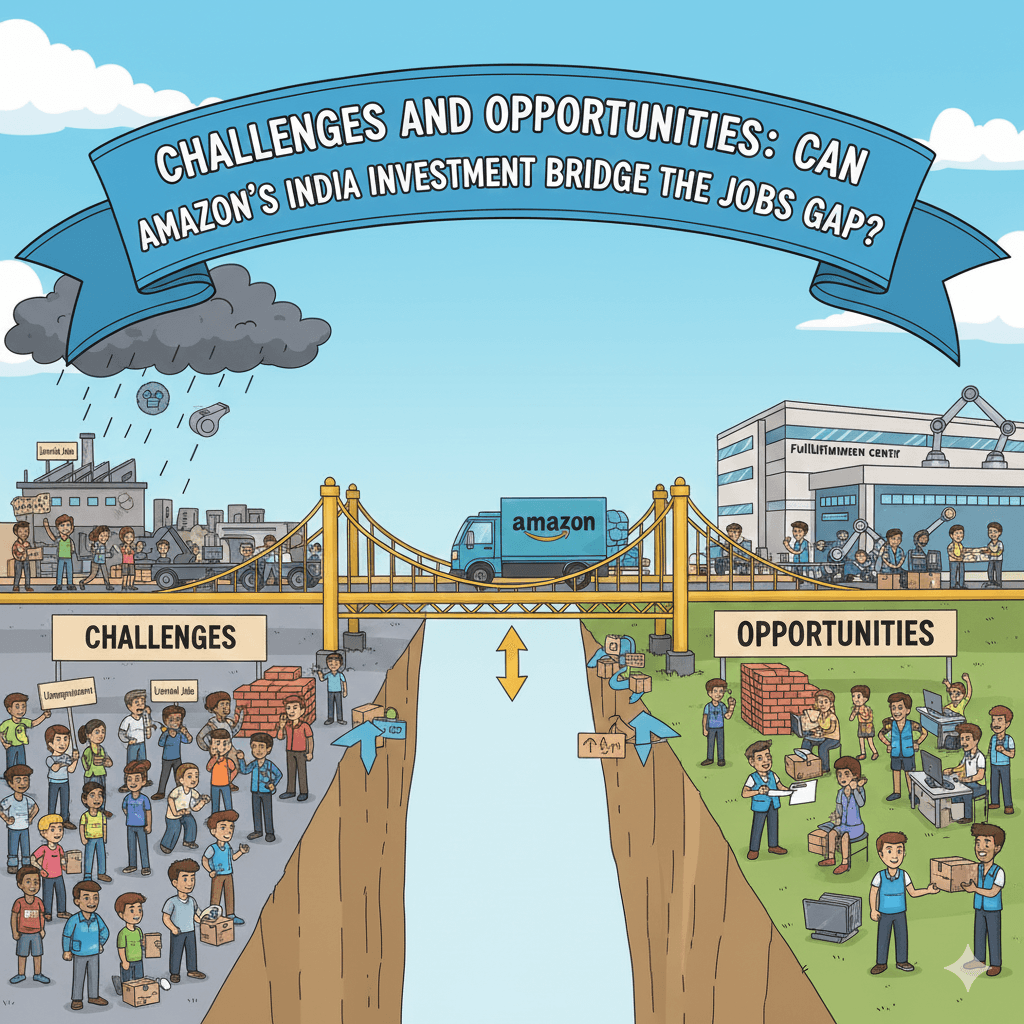
India is at a critical turning point in its economic journey. With a young population, rising digital adoption, and rapid technological change, the country faces a dual reality: immense growth potential and a widening jobs gap. In this landscape, Amazon’s massive investments in India have sparked an important question — can global tech giants like Amazon actually help bridge India’s employment gap, or do they also deepen existing challenges?
Amazon has committed billions of dollars to India across e-commerce, cloud computing (AWS), logistics, digital payments, and startup ecosystems. While this investment brings opportunities, it also raises concerns around automation, job displacement, and skill mismatch.
Let’s break this down honestly.
Amazon’s Growing Footprint in India
Amazon’s presence in India goes far beyond online shopping. Its investments span multiple sectors:
- E-commerce and seller ecosystems
- Warehousing and logistics infrastructure
- Amazon Web Services (AWS) and cloud technology
- Digital payments and fintech integration
- Startup support and MSME enablement
Through these areas, Amazon has created direct jobs (corporate roles, tech teams, warehouse staff) and indirect jobs (delivery partners, sellers, logistics vendors, support services).
This scale of investment has undeniably contributed to employment growth but the quality, stability, and future of these jobs matter just as much as the numbers.
Opportunities: How Amazon Can Help Bridge the Jobs Gap
1. Job Creation Across Skill Levels
Amazon generates employment at multiple levels:
- Entry-level warehouse and delivery roles
- Mid-level operations, HR, and management roles
- High-skilled tech jobs in data, cloud, AI, and cybersecurity
For a country like India, this multi-layered workforce demand is a major advantage.
2. Boost to the Startup and MSME Ecosystem
Thousands of Indian sellers, small businesses, and startups rely on Amazon’s marketplace to scale their operations. This has:
- Enabled entrepreneurship
- Created local employment
- Expanded access to global markets
- Many small businesses now hire more workers because of increased online demand.
3. Infrastructure and Regional Development
Amazon’s investment in warehouses, logistics hubs, and delivery networks has:
- Improved supply chains
- Generated jobs in tier-2 and tier-3 cities
- Strengthened India’s digital and physical infrastructure
This decentralization of opportunity is crucial for inclusive economic growth.
4. Skill Development and Digital Exposure
Amazon provides training in:
- Digital selling
- Cloud computing
- Logistics operations
- Technology platforms
These skills can be transferable, helping workers stay relevant even beyond Amazon.
Challenges: Why Amazon Alone Cannot Solve the Jobs Gap
1. Automation and AI Reduce Human Dependency
While Amazon creates jobs, it also heavily invests in:
- Automation
- Artificial intelligence
- Robotics
- Algorithm-driven systems
Over time, this reduces the need for human labor in repetitive roles such as sorting, packaging, and inventory management.
2. Rise of Contract and Gig Work
Many jobs created are:
- Contract-based
- Gig-oriented
- Lacking long-term security
This raises concerns around income stability, benefits, and career growth for workers.
3. Skill Mismatch in the Workforce
India produces millions of graduates every year, but:
- Not all are employable in tech-driven roles
- Many lack practical, industry-relevant skills
High-paying Amazon jobs often require advanced digital skills that a large portion of the workforce does not yet possess.
4. Concentration of Power
Heavy reliance on large private players can:
- Weaken small offline retailers
- Increase market dominance
- Reduce competition in the long run
- This can indirectly affect traditional employment sectors.
The Role of Artificial Intelligence in India’s Job Future
AI is not just reshaping Amazon it is reshaping India’s entire job market.
- Routine jobs are declining
- Demand is shifting toward analytical, creative, and tech-driven roles
- Skills like data analysis, cloud computing, AI operations, and digital management are becoming essential
The real challenge is not job loss, but job transition. Workers who fail to adapt risk being left behind.
Can Amazon Bridge the Jobs Gap Alone?
The honest answer is no but it can be part of the solution.
Amazon’s investment helps:
- Create jobs
- Boost economic activity
- Accelerate digital transformation
However, bridging India’s jobs gap also requires:
- Government policy support
- Education system reform
- Skill development programs
- Career guidance and reskilling initiatives
Without these, even large investments will benefit only a limited section of the population.
FAQs
Q1. How will artificial intelligence affect the future of jobs in India?
Ans. AI will reduce routine and repetitive jobs but increase demand for skilled roles in technology, analytics, management, and innovation. Upskilling will be essential.
Q2. How can AI impact future job opportunities?
Ans. AI creates new roles in data, automation management, cybersecurity, and cloud systems, while transforming traditional jobs into tech-supported roles.
Q3. Are Amazon jobs in India stable long-term?
Ans. Some roles are stable, especially skilled positions. However, many operational roles are contract-based and may face automation in the future.
Q4. Does Amazon help Indian startups and small businesses?
Ans. Yes. Amazon provides market access, logistics, and digital tools that help MSMEs grow and hire more people.
Q5. Can private sector investment solve unemployment in India?
Ans. Private investment helps, but sustainable employment requires education reform, skill development, and government participation.
Q6. What skills are most important for future jobs in India?
Ans. Digital skills, data literacy, problem-solving, adaptability, communication, and technology management.