Geoffrey Hinton’s Warning: AI Will Replace Everything – Here’s How Job-Seekers Can Adapt
When Geoffrey Hinton, often called the Godfather of Artificial Intelligence, warned that AI could replace a vast number of jobs, it sent shockwaves across industries. This wasn’t a random fear-mongering statement. It came from someone who helped build the very foundations of modern AI.

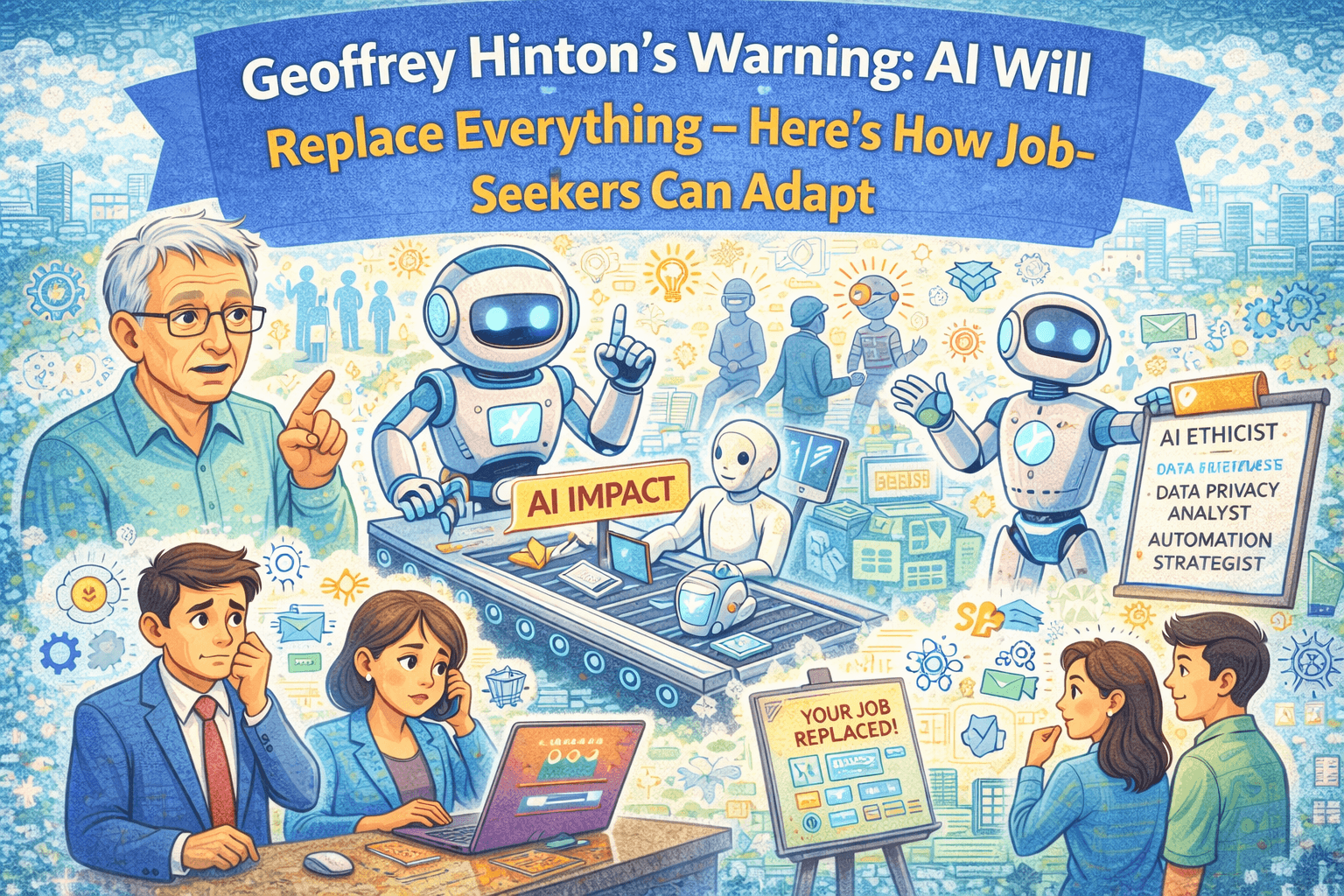
When Geoffrey Hinton, often called the Godfather of Artificial Intelligence, warned that AI could replace a vast number of jobs, it sent shockwaves across industries. This wasn’t a random fear-mongering statement. It came from someone who helped build the very foundations of modern AI.
But does this mean human work will disappear entirely? Not exactly. What will disappear are certain roles, repetitive tasks, and outdated skill sets. At the same time, new opportunities are quietly emerging for those willing to adapt.
This blog breaks down what Hinton’s warning really means, which jobs are most at risk, and how job-seekers can stay relevant in an AI-driven future.
What Did Geoffrey Hinton Actually Warn About?
Geoffrey Hinton has repeatedly highlighted that AI systems are learning faster than expected. With advancements in machine learning, neural networks, and automation, AI can now perform tasks that once required human judgment, creativity, and analysis.
His core concern isn’t that AI will assist humans, but that in many areas, it may completely replace them. Especially roles that rely on pattern recognition, data processing, and routine decision-making.
How AI Is Already Replacing Jobs
AI-driven automation is no longer a future concept. It’s already here.
- Customer support chatbots replacing entry-level call center jobs
- AI tools automating content generation, design, and data analysis
- Robotics transforming manufacturing and logistics
- Algorithms handling recruitment screening and financial analysis
These changes are improving efficiency, but they are also reshaping employment patterns across the globe.
Which Jobs Are Most at Risk?
Jobs that involve repetitive tasks, predictable workflows, or rule-based decisions face the highest risk. These include:
- Data entry and clerical roles
- Basic accounting and bookkeeping
- Tele-calling and customer support
- Routine software testing
- Assembly-line manufacturing jobs
However, roles that combine human judgment, emotional intelligence, creativity, and strategic thinking are harder to replace.
The Future of Work Is Not Job Loss, It’s Job Transformation
While some roles will vanish, many will evolve. New job titles didn’t exist a decade ago, such as:
- AI ethicist
- Prompt engineer
- Data privacy analyst
- Automation strategist
The future workforce will demand adaptability rather than a single static skill set. Continuous learning will matter more than degrees alone.
Skills That Will Matter More Than Ever
To stay relevant in the AI era, job-seekers should focus on:
- Critical thinking and problem-solving
- Digital literacy and AI awareness
- Creativity and innovation
- Communication and leadership
- Domain expertise combined with tech understanding
AI may handle tasks, but humans still excel at context, ethics, empathy, and strategy.
How Job-Seekers Can Adapt to AI Disruption
The key is not to compete against AI, but to learn how to work with it.
- Upskill regularly through short courses and certifications
- Learn how AI tools are used in your industry
- Build transferable skills that apply across roles
- Stay informed about emerging career paths
Career adaptability will be the biggest advantage in the coming decade.
FAQs
Q1. Will AI really replace all jobs?
Ans. No. AI will replace certain tasks and roles, but it will also create new jobs and transform existing ones.
Q2. Which industries will be most affected by AI?
Ans.Technology, manufacturing, finance, customer service, logistics, and media are seeing the fastest AI-driven changes.
Q3. Is it still safe to choose a traditional career path?
Ans.Traditional careers are not obsolete, but they require modernization through new skills and tools.
Q4. What skills should students focus on in the AI era?
Ans.Analytical thinking, creativity, digital skills, communication, and adaptability are crucial.
Q5. Can non-technical people survive in an AI-driven workforce?
Ans.Yes. Not all AI-related roles are technical. Strategy, ethics, management, and human-centric roles remain vital.
Q6. How can working professionals future-proof their careers?
Ans.By continuous learning, reskilling, and aligning their strengths with evolving industry needs.
Q7. Is career guidance important in the age of AI?
Ans.More than ever. With rapid changes, informed career decisions are critical.
Conclusion
Geoffrey Hinton’s warning is not a signal to panic, but a call to prepare. AI is transforming the workforce faster than traditional education and career planning systems can keep up.
This is where structured career guidance becomes essential. Organizations like Infigon Futures help students and professionals understand how their strengths align with future-ready careers. Through tools like psychometric tests, individuals gain clarity about their aptitude, interests, and adaptability in an AI-driven world.
The future of work belongs to those who understand change early and act on it wisely. AI may replace tasks, but informed humans will always shape direction.