
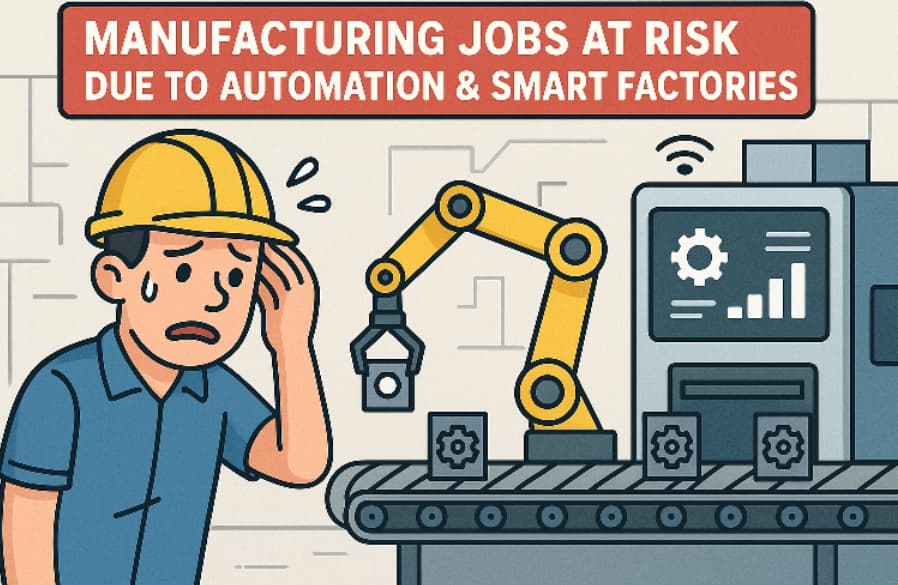
The phrase “Manufacturing Jobs at Risk Due to Automation & Smart Factories” refers to factory roles that are most likely to be reduced, transformed, or replaced by artificial intelligence (AI), robotics, and advanced manufacturing technologies. As industries upgrade, many traditional tasks that once required manual labor are now performed by machines.
Manufacturing: The Most Affected Sector
According to the World Economic Forum (WEF), manufacturing is one of the industries most heavily impacted by automation. With rapid technological improvements, factories increasingly depend on robots and AI-driven systems to handle repetitive, predictable, and precision-based tasks.
This shift directly reduces the number of human workers required on production lines.
Examples of Manufacturing Roles Being Automated:
- Assembly Line Operators
- Quality Inspectors
- Warehouse & Logistics Workers
The WEF reports that roles like machine operators and factory laborers are among the fastest-declining occupations globally.
Why Manufacturing Jobs Are at High Risk
1. Repetitive & Predictable Work
Machines outperform human workers in accuracy and consistency.
2. Efficiency Requirements
Automation ensures peak performance and minimal error rates.
3. High Productivity Demand
Smart factories operate 24/7, increasing output while reducing labor costs.
4. Cost Savings
Robots are expensive initially but cheaper long-term compared to hiring and training staff.
5. Global Competition
Industries that adopt automation faster gain economic advantage.
What This Means on the Factory Floor
The factory floor refers to where machines and workers interact within a production unit. With automation rising, many labor-intensive tasks like packaging, assembly, and routine inspection are now executed by machines.
Employment Shift on the Factory Floor
| Earlier Scenario | Present Scenario |
|---|---|
| Large numbers of workers per shift | Fewer workers per shift |
| Manual labour | Automation-driven operations |
| Regular hiring cycles | Limited or no hiring |
| Stable operational roles | Contract-based or temporary roles |
Smart Factories: Less About Skill, More About Control
Smart factories rely heavily on automated systems that monitor, control, and optimize the entire production cycle. Although they’re promoted as “innovative,” the core motive is maximizing efficiency and minimizing human error.
Automation improves productivity, safety, and precision, but it also reduces the need for human judgment. Workers mostly supervise systems instead of performing hands-on tasks.
The Organisation for Economic Co-operation and Development (OECD) states that routine, manual, factory-based jobs carry the highest automation risk.
Job Risk Based on Nature of Work
| Type of Work | Automation Risk |
|---|---|
| Repetitive manual tasks | Very High |
| Routine factory operations | High |
| Supervisory roles | Medium |
| Decision-making roles | Low |
Job Security Is the Real Concern
Automation is often blamed for job loss, but the deeper issue is long-term job security. Technology increases productivity — but only benefits workers who can upskill.
According to the International Labour Organisation (ILO), automation without upskilling increases inequality and affects entry-level and low-skilled workers the most.
Who Benefits Most from Automation?
| Group | Impact |
|---|---|
| Large corporations | High benefit |
| Factory owners | Cost savings |
| Skilled workers | Mixed outcome |
| Low-skill workers | High risk |
| Contract labour | Job instability |
A report by Oxford Economics warns that manufacturing jobs may decline substantially unless workers are transitioned into new roles — a transition that is difficult in reality.
FAQs
1. Which jobs are most at risk due to AI automation?
Ans. Roles involving repetitive, predictable tasks — such as assembly line work, clerical tasks, and customer service — are at the highest risk.
2. Which jobs face major automation risk by 2025?
Ans. Manufacturing, office support jobs, and low-skill service roles are expected to see the fastest decline.
3. How is automation affecting employment?
Ans. Routine jobs decrease, while opportunities rise in monitoring, technical maintenance, and automation management.
4. Is AI a threat to human jobs?
Ans. Yes — especially for roles with structured tasks. However, AI also creates new jobs in technical fields.
5. Can factory workers realistically reskill?
Ans. Some can, but many struggle due to limited education, age, or financial constraints.
6. Which workers are most vulnerable to job loss?
Ans. Workers performing repetitive manufacturing tasks.
7. Does automation completely eliminate jobs?
Ans. Not entirely — it transforms them. Manual tasks reduce, but technical and supervisory roles increase.