
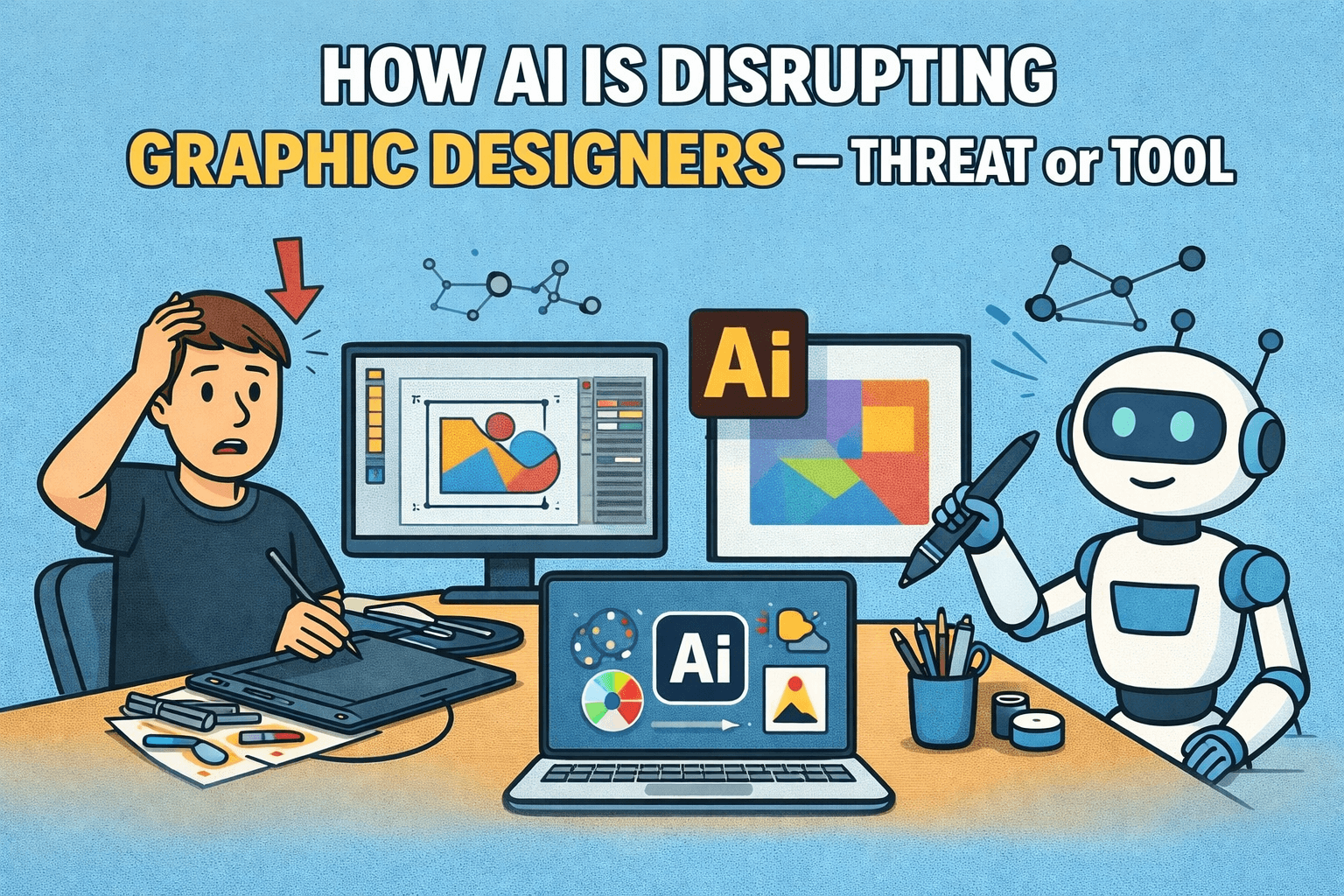
Artificial Intelligence (AI) is rapidly transforming creative industries, and graphic design is right at the center of this shift. Tools like Midjourney, DALL-E, Canva AI, and Adobe’s AI features are changing how visuals are created, edited, and delivered. This raises a big question: Is AI a threat to graphic designers—or a powerful tool that can elevate creativity? Let’s break it down.
The Rise of AI in Graphic Design
AI-powered design tools can now generate logos, posters, illustrations, and social media creatives in seconds. Tasks that once took hours—like background removal, color correction, layout suggestions, and mockups—are now automated.
Popular AI tools in design include:
- Midjourney & DALL-E for image generation
- Canva AI for quick templates and layouts
- Adobe AI (Firefly, Sensei) for professional editing
- Generative AI tools for branding and visuals
This speed and accessibility have reshaped the design workflow—but not eliminated designers.
Is AI a Threat to Graphic Designers?
AI can replace basic, repetitive design tasks, especially:
- Simple social media posts
- Template-based designs
- Low-budget logo or banner work
This means entry-level and low-skill design jobs are more vulnerable. Businesses with tight budgets may choose AI tools over hiring a designer for simple tasks.
However, AI lacks:
- Emotional intelligence
- Cultural understanding
- Brand storytelling
- Original concept development
These are areas where human designers still dominate.
AI as a Tool for Scaling Creativity
Instead of replacing designers, AI is increasingly acting as a creative assistant.
Designers now use AI to:
- Brainstorm visual ideas faster
- Generate rough drafts and concepts
- Experiment with styles and colors
- Speed up repetitive tasks
This allows designers to focus more on strategy, creativity, and problem-solving, rather than manual work. In this sense, AI is not killing creativity—it’s scaling it.
Is AI Enhancing or Limiting Creativity?
AI enhances creativity when used correctly.
✔ Enhances creativity by:
- Removing creative blocks
- Allowing rapid experimentation
- Supporting designers with inspiration
✖ Limits creativity when:
- Designs rely fully on AI outputs
- Original thinking is replaced by prompts
- Everyone uses the same AI styles
The key difference lies in how the designer uses AI—as a helper, not a replacement.
Can AI Destroy Graphic Designers’ Careers?
AI will not destroy all graphic design careers—but it will destroy outdated ones.
Designers who:
- Refuse to learn AI tools
- Stick only to basic design skills
- Avoid upskilling
may struggle.
On the other hand, designers who:
- Combine creative skills with AI tools
- Learn prompt engineering
- Focus on branding, UX, and storytelling
will be more valuable than ever.
The Future of Graphic Design Careers
The future belongs to hybrid designers—those who blend creativity with technology.
Emerging future roles include:
- AI-assisted graphic designer
- Creative technologist
- Visual strategist
- Brand experience designer
To prepare for this future, designers must develop AI skills, creative thinking, and adaptability.
FAQs
1. Would graphic design be safe from the AI trend?
Ans. Graphic design is safe for those who adapt to change. AI will replace repetitive tasks, but human creativity, storytelling, and strategy will always be needed.
2. Is AI a threat to creative jobs or a tool for scaling creativity?
Ans. AI is a tool that helps designers work faster and explore ideas. It becomes a threat only when designers stop upgrading their skills.
3. Is AI enhancing or limiting creativity in graphic design?
Ans. AI enhances creativity by offering inspiration and speed. Creativity is limited only when designers rely entirely on AI outputs.
4. Can AI destroy graphic designers’ careers?
Ans. AI can affect low-skill design roles, but skilled designers who learn AI tools will continue to thrive. Adaptability is the key.
5. What skills should graphic designers learn to stay relevant in the AI era?
Ans. Designers should learn AI design tools, creative thinking, branding, and UX basics. Combining human creativity with AI skills ensures long-term relevance.