
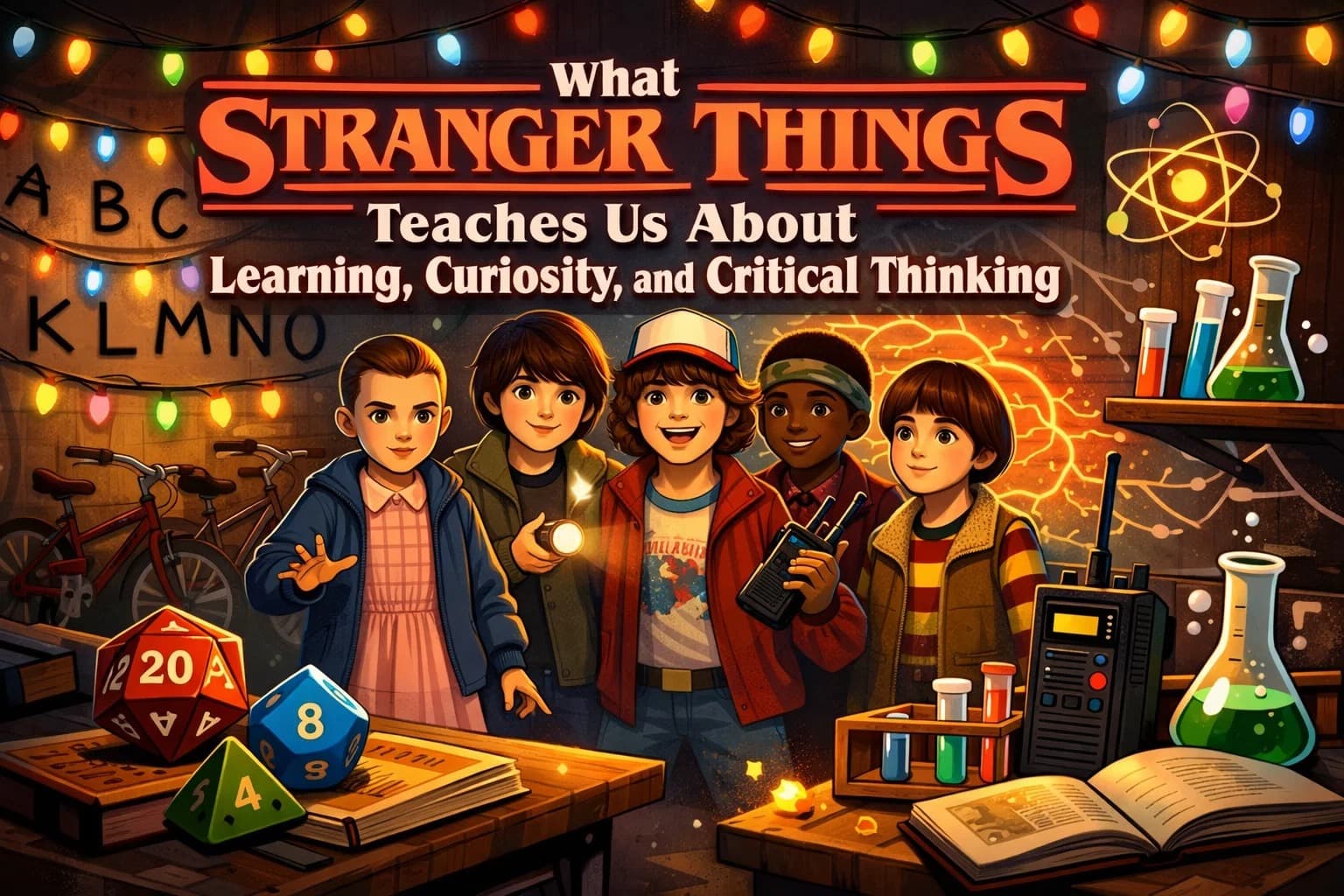
Ever wondered why a show with monsters and 80s vibe grabs so many people? The Netflix thing, Stranger Things, is more than just something to watch. It is like a lesson in figuring stuff out when things are unknown. Watching those Hawkins kids bike into trouble, you get a sense of how strong curiosity can be and how people need to find things out. The show tells us that learning does not always happen in school with books. Instead, it happens when people deal with problems that seem too hard. These characters show that being smart is not just about grades. It is about changing to fit what is happening, good friends, and being brave enough to ask questions when others do not. By checking out the Upside Down closely, you can find good lessons about how the mind works, science, and how thinking hard can save you.
Why Curiosity and Critical Thinking Go Hand in Hand
Mike, Dustin,Will and Lucas love science and how things work. They use logic to get things. When things get weird, they start figuring them out. Their Dungeons & Dragons (D&D) games help them plan and use their imagination.
➤Dustin Henderson: Acts as the bridge between fantasy and reality. He trusts science and makes inventions. He shows that wanting to be close to others makes you creative.
➤Will Byers: Represents observation and patience, his careful attention to details and ability to notice patterns often uncovers critical clues the group would otherwise miss.
➤Lucas Sinclair: Is real and does not believe everything. He makes sure the group is careful. He shows it is good to question your friends.
➤Mike Wheeler: Is usually the leader. He cares about those close to him and that drives him.
To see how shows affect STEM, read about how Stranger Things makes science cool and how that affects the real world.
How Each Character Learns
| Character | Primary Skill Set | Learning Approach | Real World Application |
|---|---|---|---|
| Dustin | Science | Curiosity driven experimentation | STEM fields and innovation |
| Mike | Leadership & Empathy | Intuition and emotional connection | Management and team building |
| Lucas | Strategy & Logic | Risk analysis and pragmatic reasoning | Crisis management and logistics |
| Will | Creativity & Sensing | Insight through experience | Arts and emotional psychology |
Eleven and Will: Learning the Hard Way
Not all your learning comes from books. Eleven and Will Byers show different ways people can be smart, based on feelings and just trying to survive. Eleven didn't know much about the world at first. She learned fast by watching and messing up. She could do crazy things with her mind, but she learned the most important stuff about trust and making friends.
➤Eleven: Shows us how to bounce back from tough times. The way she got used to living in Hawkins after escaping that lab proves your brain can change a lot.
➤Will Byers: Is really good at understanding how people feel. Being stuck in the Upside Down gave him a special feel for the scary stuff. He can sense danger before anyone else. That's like having a gut feeling, and it's a real way of thinking.
We don't always think about how bad stuff that happens to you can change how you learn. If you want to know more about how the show affects people, look at 10 life lessons from Stranger Things about growing up.
The Teens: Getting Smart in the Real World
The older teens, like Steve, Nancy, Robin, and Jonathan, prove you keep learning even after you leave school. They're always in situations where they have to think fast to stay alive.
➤Nancy Wheeler: She is a news reporter. She's curious and tries to find out the truth, even when grown-ups try to hide it. She doesn't give up, which shows you have to question what people tell you to figure things out.
➤Steve Harrington: Changes from a popular kid to a hero. He gets better by admitting when he's wrong and acting differently.
➤Robin Buckley: Knows a lot about languages and has a different way of looking at things. She cracked the Russian code in Season 3, which is a good example of solving problems when you're under pressure.
➤Jonathan Byers: Uses observation and empathy to solve problems, showing that critical thinking often involves understanding others’ perspectives.
➤Eddie Munson: Shows us growth through courage and creativity - he uses his deep knowledge of Dungeons & Dragons, leadership, and even his love for metal music to help solve problems and protect his friends, proving that learning and loyalty can come from unconventional places in life.
Just like these characters have to deal with new dangers, the real world keeps changing too. For example, read about will AI replace software developers? A realistic look at the future to see how you need to learn new skills to keep up with technology.
The Upside Down: A Crazy Class in Thinking
The Upside Down is like the hardest test ever. It's unknown, messy, and scary. To survive, you need to be able to figure things out fast. The characters have to use their brains to understand how this weird place works.
➤They pay attention: They see weird stuff like particles and how the creatures act like one big mind.
➤They guess: They use stuff they already know (like the Mind Flayer) to figure out what the bad guy wants.
➤They try things: They use heat or sound to hurt the monsters.
It's like the way scientists do things. It's a great way to get students interested in science, like biology and how the brain works. Teachers are coming up with cool ways to use the show, and you can see why teachers are using Stranger Things to make learning more relatable in modern schools.
How They Solve Problems Changes Over Time
| Season | Major Threat | Learning Theme | Key Outcome |
|---|---|---|---|
| Season 1 | Demogorgon | Friendship and Trust | Eleven discovers her power and learns she’s not alone. |
| Season 2 | Demodogs | Facing Trauma | Will uses emotional insight to spy on the enemy. |
| Season 3 | Mind Flayer | Teamwork & Codes | Robin uses language and decoding skills to break the Russian message. |
| Season 4 | Vecna | Psychology & Music | Max survives by using memories and emotional grounding. |
| Season 5 | Upside Down / Final Convergence | Critical Thinking & Collective Wisdom | The group combines experience, intuition, and learning from past mistakes to fight back together. |
Teachers can even find guides on teaching kids about Season 2 of Stranger Things. It's a cool way to bring these lessons into the classroom.
Curiosity Doesn’t Stop at Age
Even the grown-ups in Stranger Things are always learning new things. Joyce Byers and Jim Hopper go with their gut and what they've been through.
➤People think Joyce is nuts, but she's super creative when she uses Christmas lights to talk to Will. She doesn't buy the usual explanations.
➤Hopper uses his cop skills but finds out that just being tough isn't enough. He has to be smart and open.
➤It's key to get how the brain reacts when it's scared. If you want to get people interested, you can check out the science of curiosity and how fear and interest work together.
➤Karen Wheeler: In Season 5 shows that learning, curiosity, and critical thinking aren’t just for kids, even adults grow and adapt when faced with unexpected challenges.
➤Murray Bauman: Murray’s relentless investigative instincts and willingness to question every assumption - from government cover‑ups to hidden clues in Hawkins - show how curiosity and analytical thinking can uncover truths others overlook.
➤Mr. Clarke (Science Teacher): Mr. Clarke embodies the quiet power of scientific curiosity, helping the kids piece together clues, experiment, and think like scientists - proving that real learning often happens when you ask the right questions.
Understanding the brain's reaction to fear is crucial here. You can explore the neuroscience and psychology of curiosity, the key to engaging minds in the classroom to see how fear and interest interact.
Future Skills: SciFi Coming True
The show is SciFi, but the way they solve problems is real. The characters are always getting smarter to beat the next bad guy. Being able to change is what people need at work now. Whether Dustin is building a radio or Nancy is digging into a story, they're learning skills they can use anywhere.
➤Being able to change: Being able to switch gears when things go wrong.
➤Knowing tech: Solving problems with the tech you've got.
➤Working together: Using everyone's best stuff in a team.
The way jobs are changing, sales and business are too. Check out how AI is changing what salespeople do to see what's coming.
For students who want to study like Nancy or are smart like Dustin, thinking about college is normal. You might want to look at the best universities for science programs in the USA, UK, and Canada when you make plans for what's next.
Frequently Asked Questions
Q1. How does Stranger Things help students think critically?
A. The show makes you think because the characters have to watch, guess, and try things to stay alive. Kids see the Upside Down mystery needs smarts and proof, not just good luck to solve.
Q2. Can Sci-Fi shows, like Stranger Things, make you more creative?
A. Totally! Sci-Fi makes your mind bigger. It makes you imagine other worlds and stuff that could be. This gets your creative juices flowing, so you can think differently when you have your problems.
Q3. What does friendship have to do with learning in the show?
A. Friendship is like a team learning together. The characters share what they know, use each other's skills, and cheer each other on. It proves being smart is a group activity, not just a solo thing.
Q4. Is the show's psychology real?
A. The monsters are fake, but how they show trauma, fear, and being in a group feels real. Like, how Eleven deals with being alone or how the town freaks out shows how people act and feel.
Q5. How can teachers use Stranger Things in class?
A. Teachers can use it to explain physics, how media works, and how to understand characters. It is a fun way to talk about top-secret government stuff, the Cold War, and doing science the right way.
Q6. What does the show say about failing?
A. The characters mess up all the time. Their plans fail, and they get hurt. But, they treat failure like a lesson. This toughness is super important for learning new things. They figure out what went wrong and try something else next time.
Q7. Why is being curious important in Hawkins?
A. In Hawkins, if you stop asking questions, you are in trouble. Being curious pushes the characters to figure out the bad stuff before it is too late. It shows that learning stuff keeps you safe.