
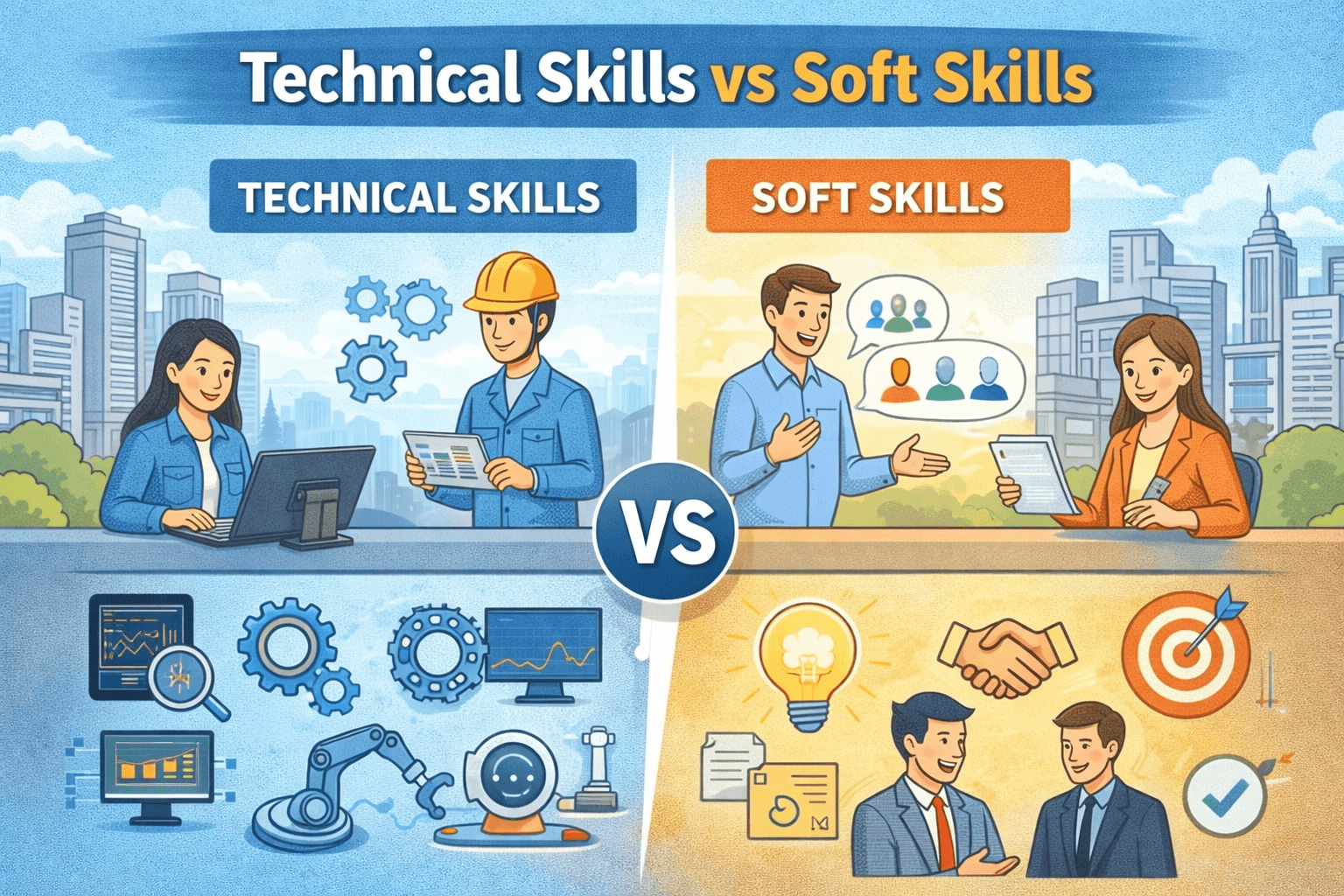
In today’s rapidly evolving job market, understanding the skills that employers value most is crucial for both freshers and experienced professionals. As we move further into 2026, what used to be a straightforward hard skills vs soft skills debate has transformed into a nuanced balancing act where both skill types play unique but interconnected roles in employability, productivity, and long-term career growth.
What Are Technical Skills?
Technical skills often called hard skills are the job-specific abilities and knowledge you can quantify and prove, like programming, machine operation, data analysis, cybersecurity, or digital marketing tools. These are typically learned through formal education, certifications, or hands-on practice.
Examples of key technical skills in 2026
- Software tools and digital platforms proficiency
- Data analysis and visualization
- Cybersecurity awareness
- Project management
- Automation and workflow optimization
Technical skills are essential to get your foot in the door. They demonstrate that you can perform the core functions of a job right from day one.
What Are Soft Skills?
Soft skills are interpersonal and behavioral abilities that shape how individuals interact with others, adapt to change, and approach problem-solving. Unlike hard skills, they are harder to measure but often determine workplace effectiveness.
Key soft skills becoming increasingly important include:
- Communication and collaboration
- Critical thinking and adaptability
- Emotional intelligence
- Leadership and professionalism
- Time management and accountability
Employers increasingly see soft skills as critical for teamwork, innovation, and long-term performance especially in hybrid, cross-functional, and AI-augmented work environments.
Technical vs Soft Skills - What Employers Want in 2026
Hiring Trends
The data shows that both skill categories are highly sought after but for different reasons:
- Technical skills
- Necessary to perform specialized tasks
- Often required to pass initial screening
- Provide credibility in emerging tech fields such as AI, blockchain, automation
Soft skills
- Highly correlated with long-term job success
- Drive effective communication, team dynamics, and leadership
- Increasingly prioritized as employers seek adaptable and forward-thinking talent
In fact, many hiring managers now rank communication as the top soft skill for 2026, followed by professionalism, time management, resilience, and problem solving.
Hard vs Soft Skills: A Balanced View
Why Technical Skills Matter Most Early
Technical skills are often your initial entry ticket into a job. Without baseline competencies like coding for developers or data analysis for analysts it’s difficult to secure interviews or meet job requirements.
Why Soft Skills Matter Long-Term
Once inside a role, soft skills determine your ability to:
- Communicate your ideas effectively
- Lead teams
- Navigate ambiguous situations
- Mentor others
- Adapt to evolving job demands
Many professionals find that technical skills get you hired, but soft skills help you grow, lead, and innovate.
Skills Needed for Future Jobs in 2026
To thrive in an AI-accelerated economy and digital-native workplace, professionals should cultivate a hybrid skillset that blends both technical and soft skills:
Top Technical Skills
- Digital literacy & AI tools
- Data analytics & machine learning fundamentals
- Cloud computing & cybersecurity
- Project management tools
- Technical writing and documentation
Top Soft Skills
- Communication & collaboration
- Creativity & innovation
- Adaptability & resilience
- Leadership & emotional intelligence
- Problem solving & critical thinking
This balanced skill mix enhances employability, increases versatility, and ensures readiness for future career paths.
How to Develop These Skills
Technical Skills
- Online training courses & certifications
- Hands-on projects
- Bootcamps and internships
Soft Skills
- Group collaborations and public speaking practice
- Real-world problem solving
- Leadership workshops
- Feedback-oriented environments
By investing in both domains, professionals become more competitive and future-ready in the evolving job landscape.
FAQs
1. Which is more important in 2026: technical skills or soft skills?
Ans. Both are equally important in 2026. Technical skills help candidates meet job requirements and pass screening stages, while soft skills like communication, adaptability, and leadership determine long-term career growth and workplace success.
2. What are the most in-demand technical skills in 2026?
Ans. Some of the top technical skills in 2026 include digital skills, data analysis, AI tool proficiency, cybersecurity awareness, cloud computing, and project management tools. These are considered essential job skills across multiple industries.
3. Why are soft skills becoming more important for future jobs?
Ans. Soft skills such as communication skills, critical thinking, emotional intelligence, and teamwork are crucial in hybrid and AI-driven workplaces. Employers value these workplace skills because they improve collaboration, innovation, and leadership effectiveness.
4. How can freshers develop technical and soft skills together?
Ans. Freshers can build technical skills through certifications, internships, and practical projects, while improving soft skills through presentations, teamwork activities, soft skills training courses, and real-world problem-solving experiences.
5. What skills are needed for future jobs beyond 2026?
Ans. Future-ready skills include a combination of hard skills like digital literacy and automation tools, along with employability skills such as adaptability, leadership skills, creativity, and strong communication skills. A balanced skillset ensures long-term career growth and relevance.