
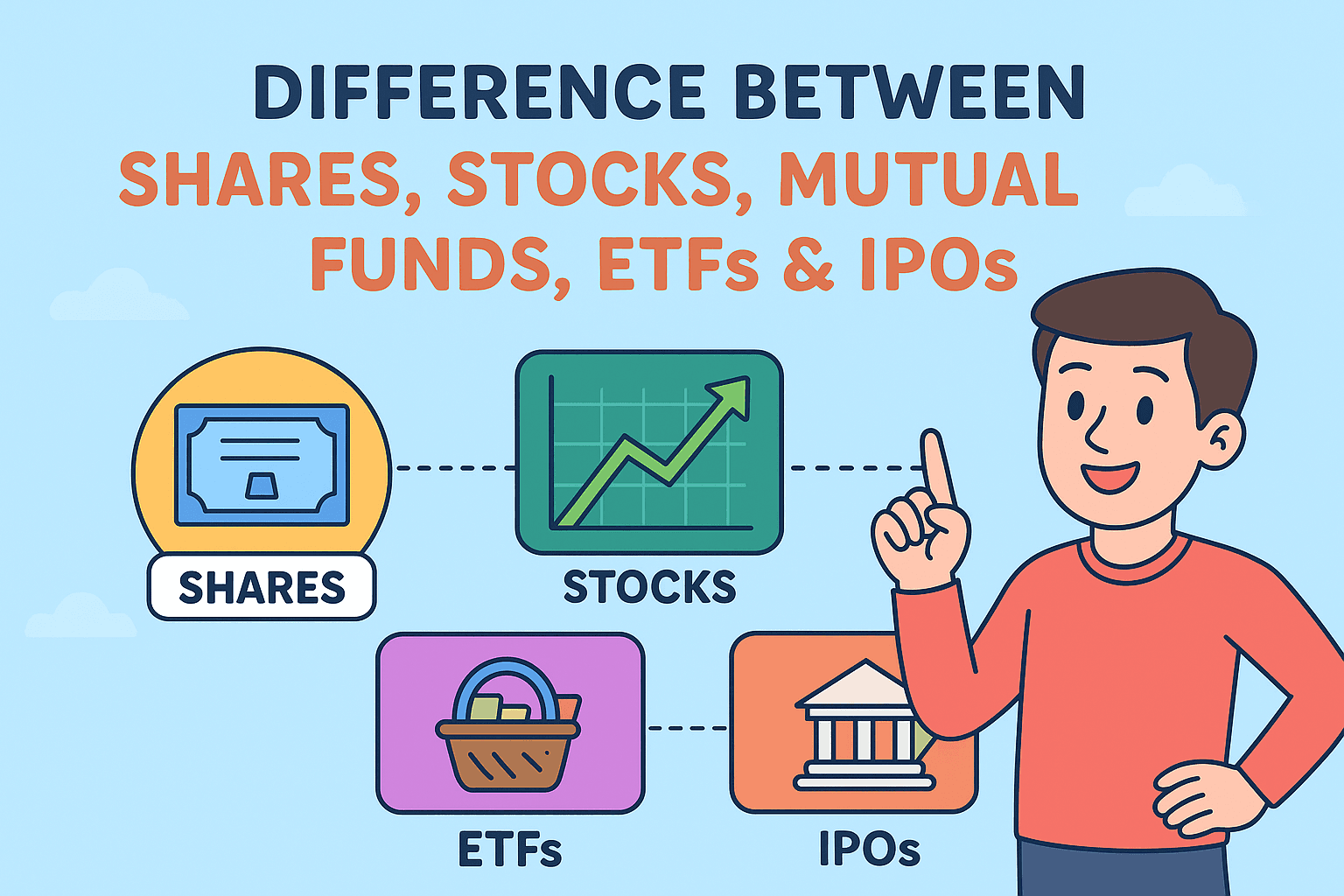
Investing is becoming a core skill for every student and young professional today. But with so many terms—shares, stocks, mutual funds, ETFs, IPOs—it’s easy to feel confused. Each of these investment options works differently and serves different types of investors. Here’s a simple, beginner-friendly guide to help you understand the difference.
Shares / Stocks
What Are Shares?
Shares represent a small ownership in a company. When you buy shares, you become a shareholder, meaning you own a tiny part of that business.
Key Points
1.Prices move up and down throughout the day.
2.Higher risk because markets fluctuate.
3.You can buy or sell anytime duiring market hours.
Who Should Invest?
People who want:
1.Direct control over their investments
2.Higher potential returns with higher risk
3.To learn market analysis
Mutual Funds
What Are Mutual Funds?
A mutual fund is a basket of investments (stocks, bonds, gold, etc.) managed by a professional fund manager.
People often ask: Which is better—ETF or mutual fund?
The answer depends on your style: funds are usually better for beginners who want automatic management.
Types of Mutual Funds
1.Equity funds
2.Debt funds
4.Gold mutual funds
Key Points
1.Managed by experts
2.Good for SIP (Systematic Investment Plans)
3.Less risk compared to buying individual stocks
ETFs (Exchange-Traded Funds)
ETF Meaning
ETF stands for Exchange Traded Fund. It’s similar to a mutual fund, but it trades on the stock exchange like a share.
ETF Full Form: Exchange Traded Fund
Examples:
1.Nifty ETF (tracks Nifty 50)
2.Gold ETF
3.Debt ETF
ETF vs Mutual Fund
| Feature | ETF | Mutual Fund |
|---|---|---|
| Trading | Bought/sold like shares | Bought directly from fund house |
| Price | Changes throughout the day | Fixed price (NAV) once per day |
| SIP availability | Some brokers allow SIP in ETF | SIP is standard |
| Management | Mostly passive | Active or passive |
Gold ETF vs Gold Mutual Fund
Gold ETF → Needs a Demat account, trades like a share.
Gold mutual fund → No Demat needed, available via SIP.
IPOs (Initial Public Offerings)
An IPO is when a company first sells its shares to the public. After the IPO listing, the shares trade in the open market like any other stock.
Key Points
1.Offers early entry into a company
2.Can give listing gains
3.Also carries risk because the company is new to markets
| Category | Meaning | Risk | Demat Required | Best For |
|---|---|---|---|---|
| Shares / Stocks | Ownership in a company | High | Yes | Active traders,long-term investors |
| Mutual Funds | Professionally managed basket of investments | Medium | No(unless using demat |
| MF) | Beginners & SIP investors | |||
|---|---|---|---|---|
| ETFs | Mutual fund+ stock trading combo | Medium | Yes | Low-cost passive investors |
| IPOs | Buy shares before market listing | Medium — High | Yes | Those seeking early opportunities |
FAQs
1. How do mutual funds differ from ETFs in terms of trading?
Ans. Mutual funds can only be bought at a daily NAV, while ETFs can be traded anytime during market hours like normal shares.
2. Should I invest in mutual funds or IPOs?
Ans. Mutual funds are safer and better for long-term beginners.
- IPOs can offer quick gains but come with higher uncertainty. Your cihoice depends on your risk level.
2. What is the difference between ETFs and individual stocks?
Ans. ETFs represent a basket of assets (low risk). A stock represents a single company (higher risk).
3. What is the difference between ETFs and individual stocks?
Ans. ETFs represent a basket of assets (low risk).
- A stock represents a single company (higher risk).
4. Are ETFs safer than individual stocks?
Ans. ETFs are generally considered less risky because they invest in a basket of assets, reducing the impact of one company’s performance.
5. Do I need a Demat account to invest in mutual funds?
Ans. No, a Demat account is not required for mutual funds. However, it is required if you want to invest in ETFs or stocks.
6. Can I start SIP in ETFs?
Ans. Yes, but not all platforms allow SIP in ETFs. Some brokers offer ETF SIPs, while mutual fund SIPs are universally supported.