
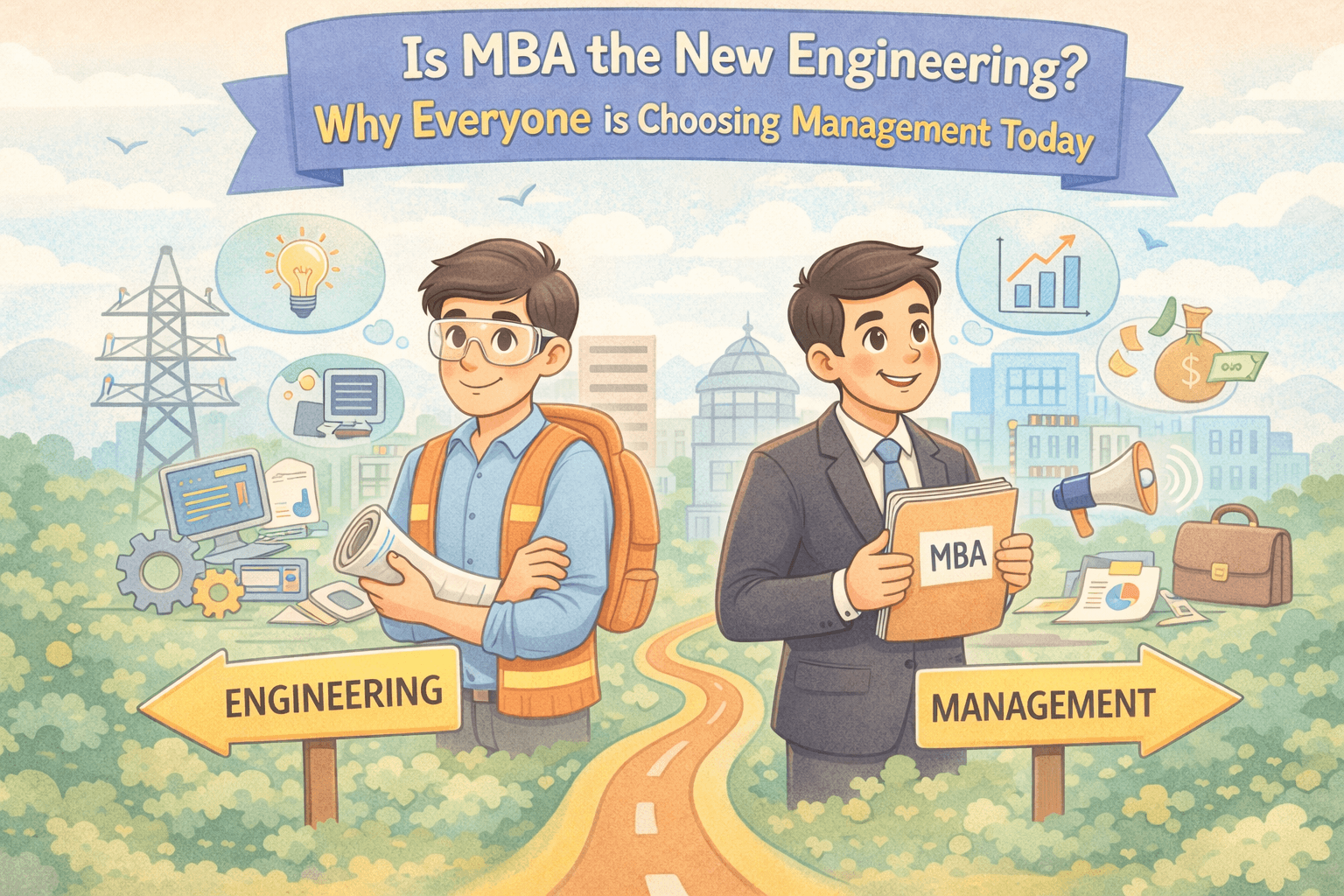
For decades, engineering was considered the safest and most prestigious career path in India. Class toppers were expected to become engineers, and engineering colleges mushroomed across the country. But today, a noticeable shift is happening. More and more students, especially engineers, are choosing to pursue an MBA. This has led to a common question: Is MBA the new engineering? The answer lies in how careers, industries, and expectations have evolved over time.
The Changing Career Landscape in India
Earlier, engineering guaranteed stability. Companies needed technical talent to build infrastructure, software, and systems. However, with automation, AI, and global competition, purely technical roles are no longer enough.
Today’s industries need professionals who can:
- Manage teams
- Understand business strategy
- Analyze markets
- Make data-driven decisions
- Bridge the gap between technology and business
This is where management education comes in. An MBA equips students with leadership, communication, financial, and strategic skills that are relevant across industries.
Why Are Engineers Choosing MBA?
One of the biggest trends in India is engineers moving toward management roles. This is not because engineering has lost value, but because career growth often slows without managerial exposure.
Many engineers realize that:
- Technical roles have limited upward mobility
- Leadership positions require business knowledge
- Decision-making power often lies with managers, not developers
An MBA helps engineers transition into roles such as product manager, business analyst, consultant, operations manager, or strategy lead. These roles offer higher responsibility, better compensation, and long-term growth.
Is MBA Replacing Engineering?
MBA is not replacing engineering, but it is complementing it. Engineering builds problem-solving and analytical thinking. MBA adds people management, business understanding, and strategic planning. Together, they create professionals who can both build and lead.
That’s why many companies prefer candidates who understand technology but can also manage budgets, clients, and teams.
Why Management Degrees Are Becoming More Popular
Several factors are driving the popularity of management education:
- Growth of startups and entrepreneurship
- Expansion of consulting and corporate roles
- Demand for leadership across sectors
- Higher salary potential over time
- Flexibility to switch industries
Unlike specialized technical degrees, an MBA allows students to work in finance, marketing, operations, HR, analytics, consulting, and even non-tech domains.
Is MBA Worth It in Today’s Job Market?
An MBA is worth it when done for the right reasons. Students who choose MBA only because “everyone else is doing it” may feel dissatisfied. However, those who align their MBA specialization with their skills, interests, and long-term goals often see strong career outcomes.
The real value of an MBA lies in:
- Skill development
- Network building
- Exposure to real-world business problems
- Leadership training ## Who Should Consider an MBA? MBA is a good choice for:
- Engineers seeking managerial roles
- Graduates interested in business and leadership
- Professionals wanting career growth or a domain switch
Students aiming for consulting, corporate, or startup careers However, it’s not a one-size-fits-all solution. Understanding personal aptitude is crucial before making this decision.
FAQ's
Q1. Why did you choose an MBA after engineering?
Ans. Many engineers choose MBA to move into leadership roles, gain business exposure, and unlock faster career growth.
Q2. Why is everyone doing MBA after engineering?
Ans. Because management roles offer broader career options, higher decision-making power, and long-term salary growth.
Q3. Why do so many engineers in India go for an MBA?
Ans. To transition from technical execution to strategic and managerial positions.
Q4. Is MBA better than engineering?
Ans. They serve different purposes. Engineering builds technical skills, while MBA builds leadership and business skills.
Q5. Is MBA useful without work experience?
Ans. It can be, but work experience often helps students gain more value from MBA programs.
Q6. Does MBA guarantee a high salary?
Ans. No degree guarantees salary. Outcomes depend on skills, specialization, college, and individual performance.
Q7. Can non-engineers do well in MBA?
Ans. Yes. MBA programs are designed for graduates from diverse academic backgrounds.