Are Online Degrees in India Worth It in 2027?
Online degrees in India are worth it when they are UGC-DEB approved and issued by a credible university. This 2027 guide covers the rules, fees, government job acceptance and how to check a programme before you pay.


Yes, an online degree in India is worth it when it is approved by the University Grants Commission (UGC) and comes from a credible university. Degrees without UGC-DEB approval carry real risk, and UGC has warned students about them repeatedly. This 2027 edition explains the rules for the 2027-28 admission session, what online degrees cost, how employers and government recruiters view them, and how to check a programme before you pay.
For working people and many students, online study offers flexibility, lower costs and access from anywhere. The trade-offs are recognition, employer acceptance and long-term career value, and these depend mostly on the programme you choose.
Are Online Degrees in India Valid? UGC Rules for 2027
Yes, but only if the specific programme is approved. Under the UGC (Open and Distance Learning Programmes and Online Programmes) Regulations, 2020, a university must get approval before it offers an online or distance (ODL) degree. The UGC-DEB (Distance Education Bureau) keeps the list of recognised institutions and programmes, and a degree from an approved programme has the same legal value as a regular degree.
For 2025-26, UGC listed 113 institutions offering 756 online programmes. That number changes each year as universities apply and get scrutinised.
Recognition window for the January-February 2027 intake
UGC opens a fresh call each year for universities that want to offer new online or distance programmes. The two most recent windows are below.
| Intake | UGC online application window | Hard copies due |
|---|---|---|
| July 2026 session | 27 April to 11 May 2026 | 20 May 2026 |
| January-February 2027 session | 1 to 15 September 2026 | 25 September 2026 |
UGC announced the January-February 2027 call on its official X account. UGC labels it academic year 2026-27, while many websites call it 2027-28, but it is the same intake. Applying is only the first step, because every application is scrutinised before UGC decides on recognition.
The next call for the July 2027 session is expected between late April and May 2027 (expected, based on the 27 April to 11 May 2026 window).
Franchise degrees and fake universities
Not every online degree in an advertisement is legitimate. UGC has said that franchise arrangements between universities and EdTech companies for online or ODL degrees are not permitted, and such degrees are not UGC-recognised. The warning dates back to a UGC notice of 16 January 2022, and the government repeated it in a Rajya Sabha reply in August 2026.
The Centre also told Parliament that 32 institutions have been identified as fake universities, based on the list published in February 2026. If an app promises a 'UGC-approved' online MBA, ask for the exact programme and check it on deb.ugc.ac.in before you pay anything.
Which Courses Can You Study Online?
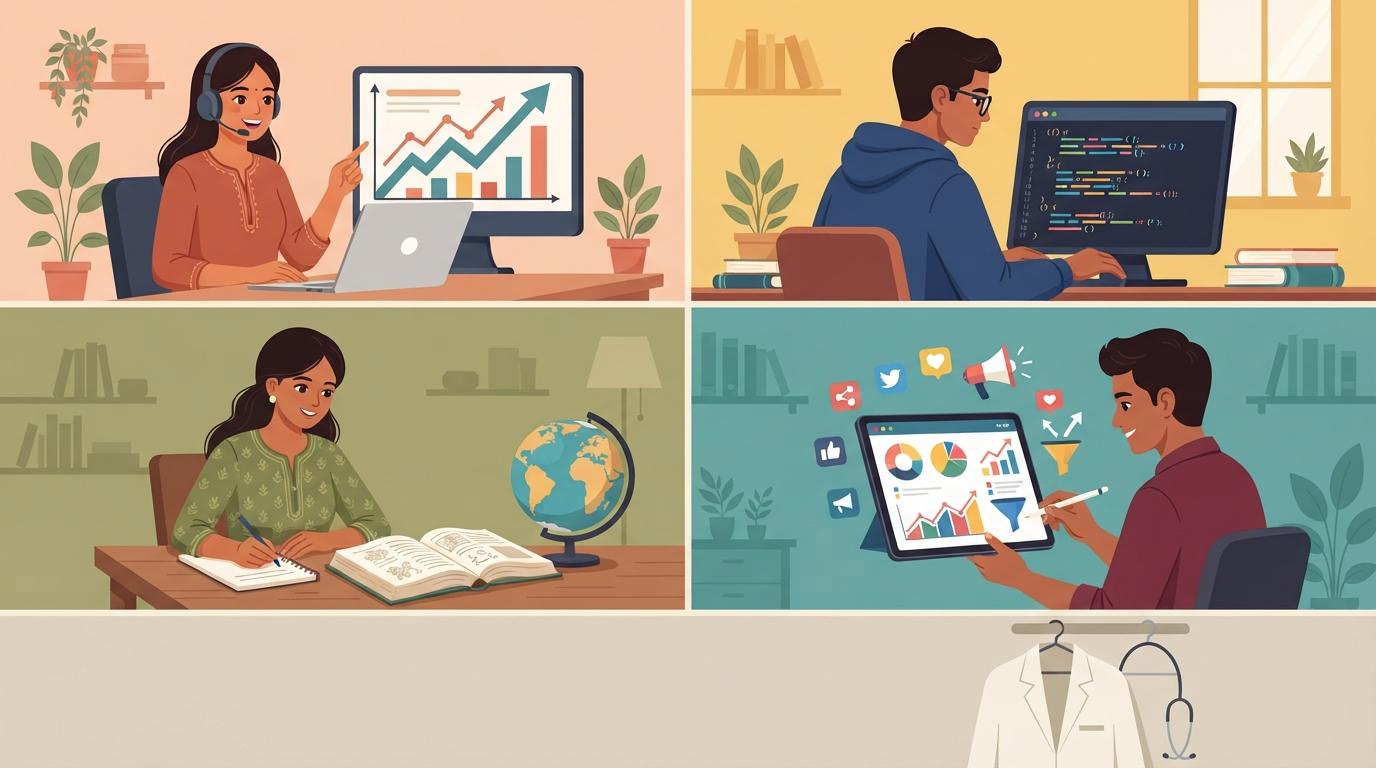
Online learning works best for subjects that can be taught through reading, recorded lectures, projects and digital assessments. The strongest choices are:
- Business and management, such as an online MBA or BBA
- Commerce, social sciences and arts, such as B.Com, BA and MA
- Computer applications and IT programmes
- Professional diplomas in data science, digital marketing and HR
Programmes that need labs, clinics or hands-on workshops cannot be delivered fully online. UGC does not allow full online or ODL delivery for medicine and allied health, engineering, architecture, pharmacy, nursing, dental, agriculture, hotel management, performing and visual arts, or PhD and MPhil programmes. So an online MBBS or BTech is not a valid route, and you should plan those courses on campus.
Not sure which path suits you? Our guide on degree versus diploma can help you decide.
How Employers and Government Jobs View Online Degrees

Private sector hiring
In IT, startups and fast-growing sectors, employers usually look at skills, projects and interview performance first. A BBA or MBA from an approved online university, backed by a strong portfolio of work, can hold its own against a campus degree. Our guide to building a career portfolio as a student shows how to present that work.
Government and PSU jobs
UGC-DEB-entitled online degrees are generally accepted for government and PSU recruitment, as long as you meet the eligibility conditions in that specific notification. Some notices ask for regular or full-time qualifications, so read the eligibility section before you apply or pay for a course.
Higher studies and academia
Degrees from large online universities, such as IGNOU and Manipal Online, are now widely accepted for postgraduate admissions. Top universities still look closely at recognition, entrance scores and course content. The worth of an online degree rests as much on the reputation of the university that issues it as on the degree itself.
What Online Degrees Cost in India
Affordability is one of the biggest advantages of online study. There is no hostel, food or relocation cost, and many students can keep their job while they study. Fees still vary widely by university and programme:
| Programme | University | Fee as listed (INR) |
|---|---|---|
| MA | IGNOU | ₹7,000 to ₹12,500 per year |
| MA (online) | Jamia Millia Islamia | ₹13,400 to ₹25,000 |
| M.Sc. (online) | MAHE | ₹2.28 to ₹2.80 lakh |
These figures come from education portals and can change from session to session, so compare the total cost of the programme, not just the first instalment. Short courses cost far less. A paralegal certificate, for example, can open doors to law-firm, NGO and compliance roles, and you can read what a paralegal does before enrolling.
Online is usually cheaper, but a cheap degree from an unapproved provider is the most expensive mistake you can make.
How to Check an Online Programme Before You Pay

Use this checklist before you pay any fee:
- Confirm UGC-DEB approval. Search the university and programme on deb.ugc.ac.in. Students joining an online or ODL programme also need a DEB ID, which is linked to their ABC ID and lets you verify enrolment.
- Make sure the university awards the degree. A degree run through an EdTech franchise is not UGC-recognised, so the certificate should come from the university itself.
- Check the university's quality. UGC's eligibility rules look for strong NAAC accreditation or a place in the NIRF rankings, so check both.
- Look at how you will be assessed. Serious programmes use proctored exams, written projects and assignments, not only multiple-choice tests.
- Ask alumni. Search for graduates on LinkedIn and ask about their jobs and salaries. Their experience shows whether the course delivers results.
When Online Degrees Make Sense and When They Don't
| An online degree is a good fit if you | A regular degree is the better choice if you |
|---|---|
| Are working and want to study without quitting your job | Want a career in labs, clinics, workshops or fieldwork |
| Live in a small town and cannot move to a big city | Depend on campus placements and alumni networks |
| Want to switch careers or move into management | Are unsure whether the course is UGC-DEB approved |
| Need an affordable route to quality higher education | Want a campus environment to build confidence and skills |
Online study is a smart long-term investment only when the programme is approved and matched to your goals. If you are unsure whether your interests and working style suit distance learning, a psychometric assessment can give you a clearer picture. You can also talk to a career counsellor who will help you compare options before you commit.
Frequently Asked Questions
Can online degrees be accepted for government jobs?
Yes, UGC-DEB-entitled online degrees are generally accepted for government and PSU recruitment. You must still meet the eligibility conditions in the specific notification, and some notices ask for regular or full-time qualifications. Before you enrol, confirm that the programme is UGC-DEB approved and that the degree will be awarded by the university itself, in your name.
Is an online MBA in India worth it?
It can be, if the programme is UGC-DEB approved, offered by a university with strong accreditation, and includes projects and proctored assessments. It suits working professionals who want a promotion or a career switch without leaving their jobs. It is not a direct substitute for a campus MBA if your goal is campus placements at top business schools.
What is the difference between distance and online education?
Distance education usually relies on printed or recorded study material, with occasional contact classes or exams. Online education runs on digital platforms with live or recorded sessions and online assessments. Both can be UGC-DEB approved, so the approval of the specific programme matters more than the label.
What is a DEB ID and do I need one?
A DEB ID is an identification number for students enrolled in online or ODL programmes. It is linked to your ABC ID, and it helps you verify that your programme and enrolment are recognised on deb.ugc.ac.in. If you are joining an online programme, ask the university how it will issue your DEB ID.
Which courses cannot be done online in India?
UGC does not allow full online or ODL delivery for medicine and allied health, engineering, architecture, pharmacy, nursing, dental, agriculture, hotel management, performing and visual arts, or PhD and MPhil programmes. An online MBBS or online BTech is therefore not a valid route to a recognised degree, so these courses need classroom and lab training.
Are degrees from EdTech platforms valid?
Only if the programme is UGC-DEB approved and the university itself awards the degree. UGC says franchise arrangements between universities and EdTech companies for online or ODL degrees are not permitted, and such degrees are not UGC-recognised. Ask for the programme's approval details in writing before you pay any fee.
Is IGNOU admission open for 2027?
IGNOU runs admissions in January and July every year, so the January 2027 intake is the next cycle. Its July 2026 admissions portal opened on 25 May 2026. For online programmes with a February intake, the last admission dates were 31 March 2024 and 30 March 2026, so the 2027 deadline is expected around 31 March 2027 (expected, based on those two years).
Conclusion
Online degrees are worth it in India when they are UGC-DEB approved, issued by a credible university and matched to your career goals. They offer flexibility, lower costs and access from anywhere, which makes them a strong choice for working professionals and students outside big cities. For lab-based, clinical or campus-heavy careers, a regular degree remains the better route.
If you are still confused about which path fits you, connect with Infigon Futures and talk to a career expert who can look at your interests and goals with you.
Before you decide: two free 2-minute checks
- 2 min · freeAre you AI-proof?AI will take the work of people who only do what a machine can do. Ten questions show your AI-proof score and your biggest gap.Check my AI-proof score
- 1 min · freeWhen will you earn your dream salary?Pick a career and the monthly salary you have in mind. See at what level and around what age people in that career get there, if they do.Run the salary reality check