
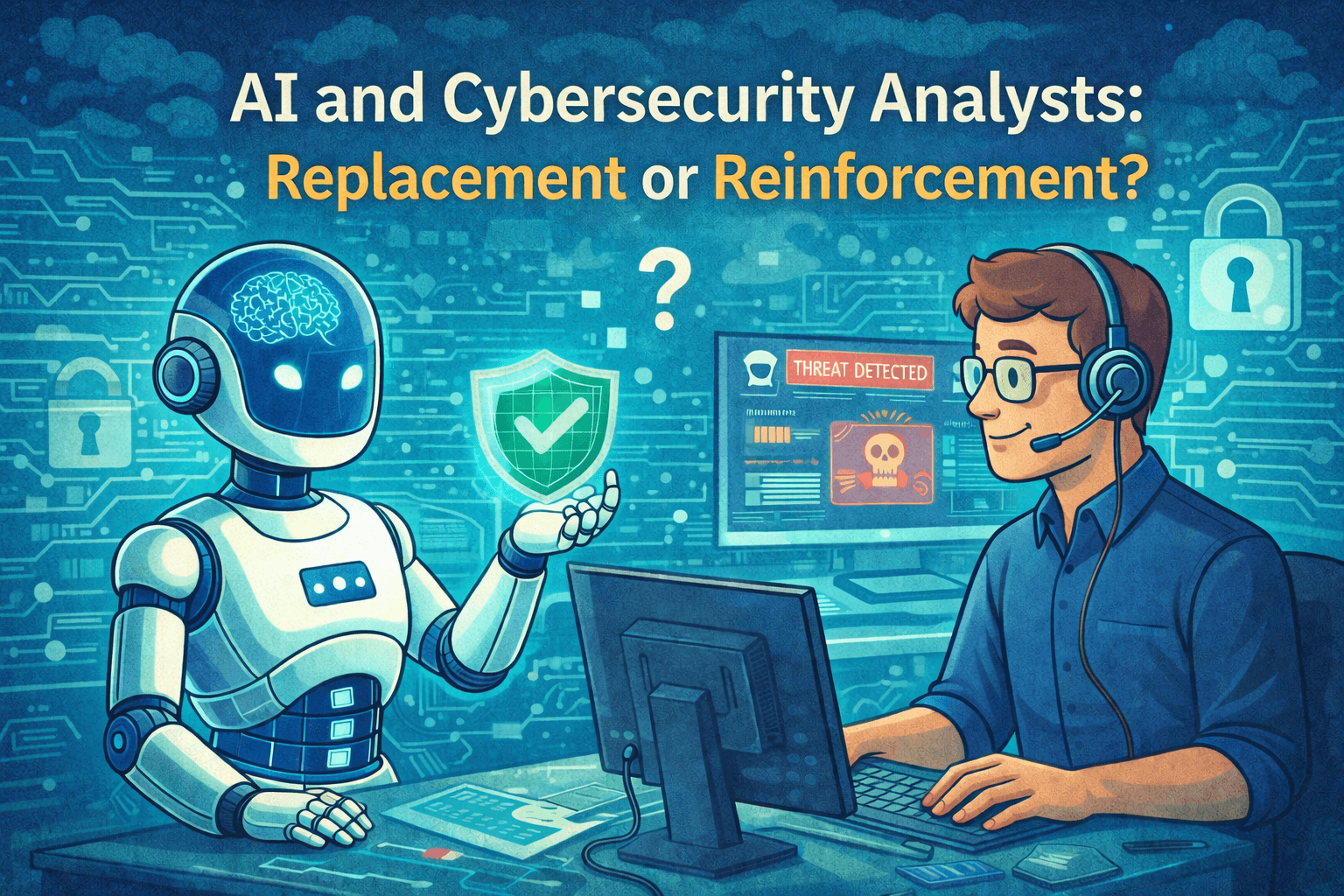
As artificial intelligence (AI) continues to transform industries, one big question worries students and professionals alike: Will AI replace cybersecurity analysts, or will it strengthen their role?
With cyber threats increasing every day and technology evolving rapidly, cybersecurity has become one of the most critical fields in IT. AI is now deeply involved in detecting threats, preventing attacks, and automating security tasks — but that does not automatically mean human roles are disappearing.
Instead of replacement, the reality is more nuanced.
How AI Is Changing Cybersecurity
AI is being widely adopted in cybersecurity because of its ability to process massive amounts of data quickly and identify patterns that humans may miss.
Some key areas where AI is already making an impact include:
- Threat detection: AI systems analyze network traffic to detect unusual behavior and potential cyber threats in real time.
- Malware detection: Machine learning models can identify new and unknown malware based on behavior rather than known signatures.
- Incident response: AI helps prioritize alerts, reduce false positives, and suggest response actions.
- Risk management: AI supports predictive analysis to assess vulnerabilities before attackers exploit them.
These capabilities make cybersecurity systems faster, smarter, and more efficient.
Does AI Replace Cybersecurity Analysts?
The short answer is no.
AI excels at handling repetitive, data-heavy tasks, but cybersecurity is not just about detecting threats. It also involves:
- Strategic decision-making
- Understanding attacker intent
- Ethical judgment
- Business context awareness
- Designing security policies
Handling complex, evolving cyber incidents
AI tools work based on data and algorithms, while cybercriminals constantly change tactics. Human analysts are essential to interpret AI outputs, investigate advanced threats, and make judgment calls during critical incidents.
Rather than replacing analysts, AI reduces workload and allows professionals to focus on high-level security challenges.
AI as a Reinforcement Tool
In reality, AI acts as a force multiplier for cybersecurity professionals. AI helps analysts by:
- Automating routine monitoring
- Reducing alert fatigue
- Speeding up threat analysis
- Supporting faster decision-making
- Improving accuracy in threat detection
This makes cybersecurity roles more powerful and impactful, not obsolete.
As cyber threats grow in complexity, organizations need skilled analysts who can work with AI systems, not compete against them.
New Skills Cybersecurity Analysts Need
With AI becoming a core part of security systems, the role of a cybersecurity analyst is evolving.
Future-ready analysts should focus on:
- Understanding AI and machine learning basics
- Network security and data security fundamentals
- Incident response planning
- Risk assessment and compliance
- Ethical hacking and threat modeling
- Security automation tools
Cybersecurity jobs are shifting toward hybrid roles where technical expertise and analytical thinking are equally important.
Career Outlook: The Future of Cybersecurity Jobs
The demand for cybersecurity analysts continues to grow globally. As businesses, governments, and individuals rely more on digital platforms, cyber risks increase and so does the need for skilled security professionals.
AI does not reduce job opportunities; it changes the nature of the job.
Professionals who adapt, upskill, and understand AI-driven security tools will remain highly valuable in the job market.
FAQs
Q1. How is AI being used to improve cybersecurity?
Ans. AI is used for threat detection, malware analysis, monitoring networks, incident response, and identifying vulnerabilities faster than traditional methods.
Q2. How good is AI at solving cybersecurity problems?
Ans. AI is excellent at analyzing large data sets and detecting patterns, but it lacks human judgment, creativity, and contextual understanding.
Q3. Can AI fully replace cybersecurity analysts?
Ans. No. AI supports analysts but cannot replace human decision-making, strategic planning, and ethical judgment.
Q4. Are cybersecurity jobs safe in the future?
Ans. Yes. Cybersecurity jobs are expected to grow as cyber threats increase across industries.
Q5. Do cybersecurity analysts need to learn AI?
Ans. Basic knowledge of AI and machine learning is becoming important to work effectively with modern security tools.