Which Stream Is Best After 10th? How to Actually Decide
There is no single best stream after Class 10. This guide shows how to match Science, Commerce or Humanities to your interests, subjects and career goals, with a self-test and the common mistakes to avoid.

Arham Ansari
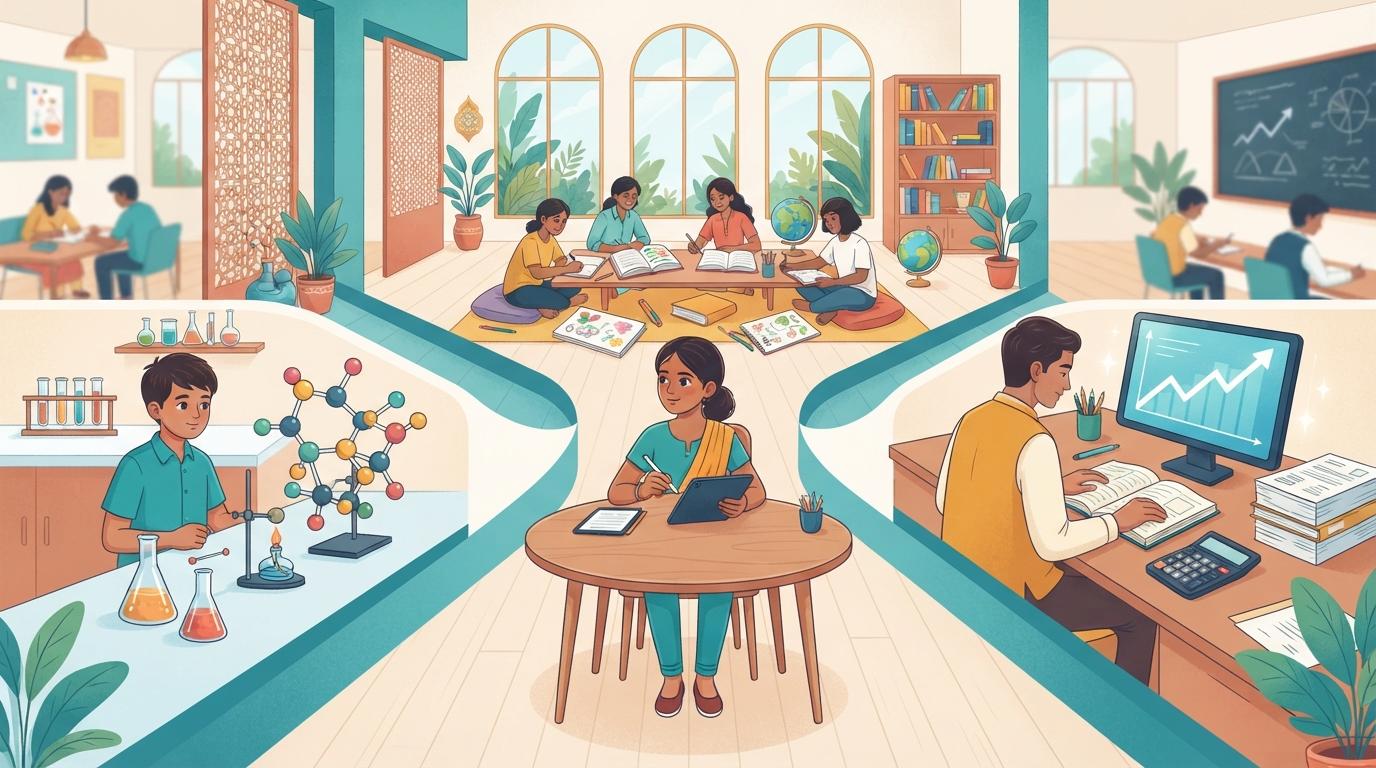
If you are finishing Class 10, you have probably asked yourself which stream is best after 10th. The honest answer is that no stream is best for everyone. The right stream is the one whose subjects hold your interest, that fits the career you are moving towards, and that suits the way you learn.
CBSE schools offer three main streams: Science, Commerce and Humanities (also called Arts). Science is usually split into two groups, Medical and Non-medical. This guide explains how to decide with evidence rather than pressure, what each stream leads to, and the mistakes families make most often.
Why 'Which Stream Is Best After 10th' Is the Wrong Question
A stream is a bundle of subjects for the next two years. It is not a verdict on your intelligence or your future. Asking which stream is best skips the more useful question: best for whom, and for which career?
Consider two students. One loves numbers, enjoys reading history for fun and wants to become a chartered accountant. The other wants to become a doctor and is fascinated by biology. Both have excellent options, and the best stream for each is different.
Three points make this clearer:
- The National Education Policy 2020 says school education should have no hard separation between arts, humanities and sciences, or between vocational and academic streams. The aim is flexibility, not ranking.
- This policy is rolling out school by school. Which subject mixes you can take depends on your school's combination list, so treat the policy as a direction, not a guarantee.
- Entrance exams still ask for specific subjects. PCM (Physics, Chemistry, Mathematics) is the usual route for engineering entrance, and PCB (Physics, Chemistry, Biology) is the usual route for medical entrance.
So the goal is not to find a 'best' stream. It is to find the stream that keeps the most good futures open for you, given what you enjoy and what you are good at.
What Each Stream Actually Leads To
Each stream opens a different set of routes after Class 12. The table below shows typical subjects and common paths. Use it as a starting point, not a guarantee.
| Stream | Typical subjects | Common routes after Class 12 | Often suits students who |
|---|---|---|---|
| Science (Non-medical) | Physics, Chemistry, Mathematics, plus English and a language | Engineering, architecture, data science, research, science degrees | enjoy problem-solving, maths and experiments |
| Science (Medical) | Physics, Chemistry, Biology, plus English and a language | MBBS, BDS, nursing, pharmacy, veterinary science | care about living systems and patient-facing work |
| Commerce | Accountancy, Business Studies, Economics, plus English and a language | Chartered accountancy, company secretary, B.Com, BBA, banking, finance | like business, markets, money and structured rules |
| Humanities (Arts) | History, Political Science, Geography, Psychology, Sociology, plus English and a language | Law, psychology, journalism, design, teaching, public policy, civil services preparation | enjoy reading, writing, society, people and ideas |
A few things the table does not show. Many degrees accept students from more than one stream, so your Class 11 choice does not lock you in forever. However, switching is harder when you have already spent two years on subjects that do not match your goal.
Humanities is not the lesser choice. Students who choose it with conviction often build strong careers in law, communication, psychology, design and policy. Likewise, Science is not automatically the safe choice. What matters is whether you can see yourself working in the field and whether you enjoy the subjects enough to keep going.
If you already have a career in mind, look at what it requires. A chartered accountant career, for example, is built around accounts and finance, which points towards Commerce. Work backwards from the career to the subjects, not the other way round.
Marks Are Not the Deciding Factor: Here Is What Is
Marks matter for admissions, but they tell you where you have done well, not where you will thrive. A student who scored 90 percent in Science may find that the work bores them after a year. A student with 75 percent in Commerce may discover that they love the subject and do far better once they are engaged.
The factors that predict a good fit are:
- Interest that lasts: the subjects you pick up on your own, read about without being asked, or lose track of time in.
- Aptitude: how you handle problem-solving, numbers, language, logic, or hands-on practical work.
- Career direction: even a rough idea of the work you want to do.
- Learning style: whether you learn best through experiments, reading and writing, debate, or field work.
- Practical realities: the cost of the course you need, where you would study, and the support you will get at home.
If you are on CBSE, there is also a new factor to consider. Class 10 now has two board exams. The Main Board Examination ran from 17 February to 11 March 2026, and the Second Board Examination ran from 15 to 21 May 2026. CBSE uses the better of the two performances, and the combined pass percentage was 96.78%, as announced in the CBSE press release and reported by All India Radio.
The second exam is optional and is meant for improvement. It is not a compulsory second attempt. For students who want to raise a score, it offers a chance to do so before the stream decision is final, and the combined results give families a clearer picture of marks.
Marks tell you what you can score. Interest and aptitude tell you what you will keep doing after the exam is over.
The Four Mistakes Families Make at This Stage
Most stream decisions that go wrong follow one of these four patterns.
- Choosing Science for prestige, then switching later. Many students pick Science because it feels like the safest or most respected option. They then move to a commerce or arts degree in college. The switch costs time and money, and the two years of subjects they did not want are lost. The 5 mistakes students make while choosing a career article covers more of these traps.
- Believing Arts is only for students who cannot get into Science. This myth discourages capable students from choosing subjects they would enjoy. Humanities leads to law, journalism, psychology, design, teaching and public policy, all of which need strong thinking and skill.
- Letting one person decide alone. Parents know their child well, and their concern is real. But the student will be doing the work for two years, so their own view should carry real weight. The best decisions are made together, with the student leading the reasoning.
- Following what peers or relatives choose. A stream that suits your cousin or your best friend may not suit you. Compare your own interests and goals, not the group's.
Our parent guide to stream selection after 10th covers the family side of this decision in more depth. This article focuses on how the student can test their own fit.
How to Test Your Fit Before You Commit
You do not need to guess. A few simple steps will show you where you fit best.
- List the subjects you enjoy and why. Write down what you like about each one: the lab work, the reading, the puzzles, the arguments, the numbers. Patterns in your reasons matter more than the subject names.
- Check the combinations your school offers. Ask the school which subject combinations are available, and whether mixing subjects across streams is allowed in your school. Your options are only as wide as the school's list.
- Pick three careers you can picture yourself doing. For each one, note the degree or entrance exam it needs. If two of your three careers need the same subjects, that is a strong signal.
- Try the work before you commit. Watch a professional at work, attend a short online course, or ask a family friend in the field for a 30-minute conversation. Ask what a normal week looks like, not just what the job pays.
- Take a structured assessment. A psychometric test measures interests, aptitude and personality in a consistent way. At Infigon Futures, the results are discussed with a certified career counsellor, who links them to real subject combinations and careers.
- Run the final check. Ask yourself three questions. Do the typical subjects of this stream match what I enjoy? Would I still want to study this in Class 12 if the marks were average? Can I name one course and one career that this stream leads to?
If you answer yes to most of these, you have a strong fit. If not, go back to step one and look at the next stream on your shortlist.
Try the Stream Selection Test for Class 10 Students
If you want a structured starting point, our Stream Selection Test for Class 10 students is an online test made for students who have just finished Class 10. It helps you see which stream may fit your interests and abilities. Use the result as one input alongside your marks, your school's subject combinations and what you learn from talking to people in the field.
A test cannot make the decision for you, but it can show patterns you might miss. If the suggested stream matches the subjects you enjoy and the careers you can picture, that is a useful sign. If it does not, go back to the steps above and compare the two streams again.
What to Do If You Still Cannot Decide
Being undecided is normal. Many students feel stuck at this stage, and that does not mean they are making a mistake. It means they need a clearer process.
Start by shortlisting two streams, not three. Test both over a few weeks: read about the careers, talk to someone in each field, and note which subjects you look forward to. Keep the other options in mind, but give the two shortlisted streams a fair chance.
Ask your school which combinations keep the most doors open. Some subject mixes make it easier to move between engineering, commerce and science degrees later. Choosing a combination that keeps your options open can take pressure off a final decision.
If you are still in Class 8 or 9, counselling can start early to build interest and self-awareness. The final stream choice is best made later in Class 10, when you have a clearer picture of your marks, your interests and your goals.
If you feel stuck, our guide on how to choose a career when you have no idea what you want walks through the steps. You can also learn what career counselling involves before deciding whether a session would help.
Frequently Asked Questions
Which stream is best after 10th: Science or Commerce?
Neither is better in general. Science suits students who enjoy physics, chemistry and either maths or biology, and who want engineering, medical or research routes. Commerce suits students who like accounts, business and economics, and who want routes such as chartered accountancy, company secretary or management. Choose by interest and career goal, then check which subjects your school offers.
Can I mix subjects from different streams in Class 11?
The National Education Policy 2020 aims to remove hard separation between streams, so mixing subjects is becoming possible. Whether you can do it depends on your school, because subject combinations are set by individual schools. Ask for the school's list of combinations before you decide, and check that the mix you want still keeps your entrance exam routes open.
Is the second Class 10 board exam compulsory?
No. For CBSE students the second Class 10 board exam is optional and is meant for improvement. CBSE uses the better of the two performances. In 2026 the second exam ran from 15 to 21 May, with a fee of ₹320 per subject for Indian students. If you are happy with your Main Board Examination result, you do not need to sit the second exam.
Can a student skip the first board exam and sit only the second?
No. The first Main Board Examination is mandatory for CBSE Class 10 students. The second board exam is an optional extra attempt for students who want to improve a result. Every student takes the first exam, and only those who want to raise their marks take the second.
Do I need PCM or PCB for entrance exams after Class 12?
It depends on the course. Engineering entrance exams usually expect PCM, which means Physics, Chemistry and Mathematics. Medical entrance exams usually expect PCB, which means Physics, Chemistry and Biology. Check the eligibility section of each exam's official information bulletin, because subject rules can differ.
Is the best stream for girls different from the best stream for boys?
No. Stream choice should follow a student's interests, aptitude and career goals, not gender. Girls and boys both succeed in Science, Commerce and Humanities. If a family member or teacher suggests a stream based on gender, ask what evidence supports it, and compare it with the student's own strengths.
Can students from Arts or Humanities earn high salaries?
Yes, but salary depends on the specific career, skills, qualifications and experience, not just the stream name. Humanities graduates work in law, journalism, psychology, design, teaching, public policy and many other fields. Building strong writing, research, data and communication skills early improves the chances of a strong income in any stream.
Conclusion
If you are still confused about which stream fits you, you are not alone, and one honest conversation can save months of second-guessing. You can start with our Stream Selection Test for Class 10 students, then connect with Infigon Futures and talk to a career expert who will look at your interests, marks and goals together.
Before you decide: two free 2-minute checks
- 2 min · freeAre you AI-proof?AI will take the work of people who only do what a machine can do. Ten questions show your AI-proof score and your biggest gap.Check my AI-proof score
- 1 min · freeWhen will you earn your dream salary?Pick a career and the monthly salary you have in mind. See at what level and around what age people in that career get there, if they do.Run the salary reality check